Monday, 26 May 2014

Review of the Midori MD A5 lined notebook

Two reviews in two days... At this rate, I might actually review all my new notebooks before buying some more...
[ha, ha, ha, ha, ha, ha, ha... who are you trying to kid ???????]

Anyway, today it is the turn of the Midori MD A5 lined notebook, bought in The Journal Shop’s 20% off everything sale. Again, no affiliation, just a happy customer. As ever, click on any picture for a bigger version.

I bought the Midori MD notebook because I was intrigued. I haven’t got a Midori Traveller Notebook but I have heard good things about the paper and it is the same paper used in these notebooks.

Overview:
It’s a good notebook. The paper is fabulous. I’m not convinced by the bold line across the middle. There are 176 non-numbered pages. The notebook is 149mm x 210mm.

Front cover

Detail:
Cover:

The notebook had a slip-cover of what feels like waxy tissue paper. I’m sure it has a proper name (tell me what it is in the comments if you know it!). Around the outside of that was a label, which was all in Japanese, so I can’t tell you what it says.

Back cover (still in the plastic wrapper)
Waxy tissue paper slip cover

Once you remove the slip cover and loose label, you see the cover of the notebook. It is made of thick cream card, with a small “MD paper Made in Japan” logo embossed in the middle of the RHS. The binding is hard to describe – it looks like an open-weave bandage that has been firmly glued to the spine. Again, this probably has a proper name and again, tell me in the comments what it is if you know it! The pages are bound with thread-stitching.

Front cover with slip-cover tissue paper reflected back

There is no pocket in the back – this is a basic notebook.

Inside:
The first page has a space for putting something – title, picture, whatever. Underneath the space is MD Notebook Made in Japan and the Midori logo. Inevitably, this page is glued to the next (the next being the first lined page of the book) so that the next page doesn’t open out fully. There were two labels (and a blank one) – ‘idea’ and ‘diary’ though I am not sure where they are supposed to go – they are too big for the box-space on the first page and I think the spine is too rough for them.

First page
Labels

The pages have 27 lines with a line-spacing of 7mm, a top margin of 16mm, a bottom margin of 12mm and an inner margin where the lines don’t reach the spine of 2mm. The 14th line down (in the centre of the page) is bold.
I do not know why. Nor do I much care for it. It remains to be seen how much this will piss me off when I use the notebook, but at first glance it’s annoyed me.
The page edges are all squared and extremely smooth-feeling.

Bold central line.

The paper is lovely to write on. Forgive the crumpled look to the pages – I didn’t extract them from the book very well (I was worrying more about the book than the removed pages to be honest!). The book also lies as flat as a bat! The open-weave bandage/thread-stitching binding works a treat! There is a page marker of narrow, dark green ribbon.

Fountain Pen Tests:
The paper was glorious to write on (as you might anticipate, it being Midori and all that). No feathering, nice crisp lines, smooth and not too ‘grabby’ but one of my inks took a while to dry as a consequence of the surface of the paper, so lefties may want to just test out their pen/ink combos.

Fountain pen tests - no feathering...

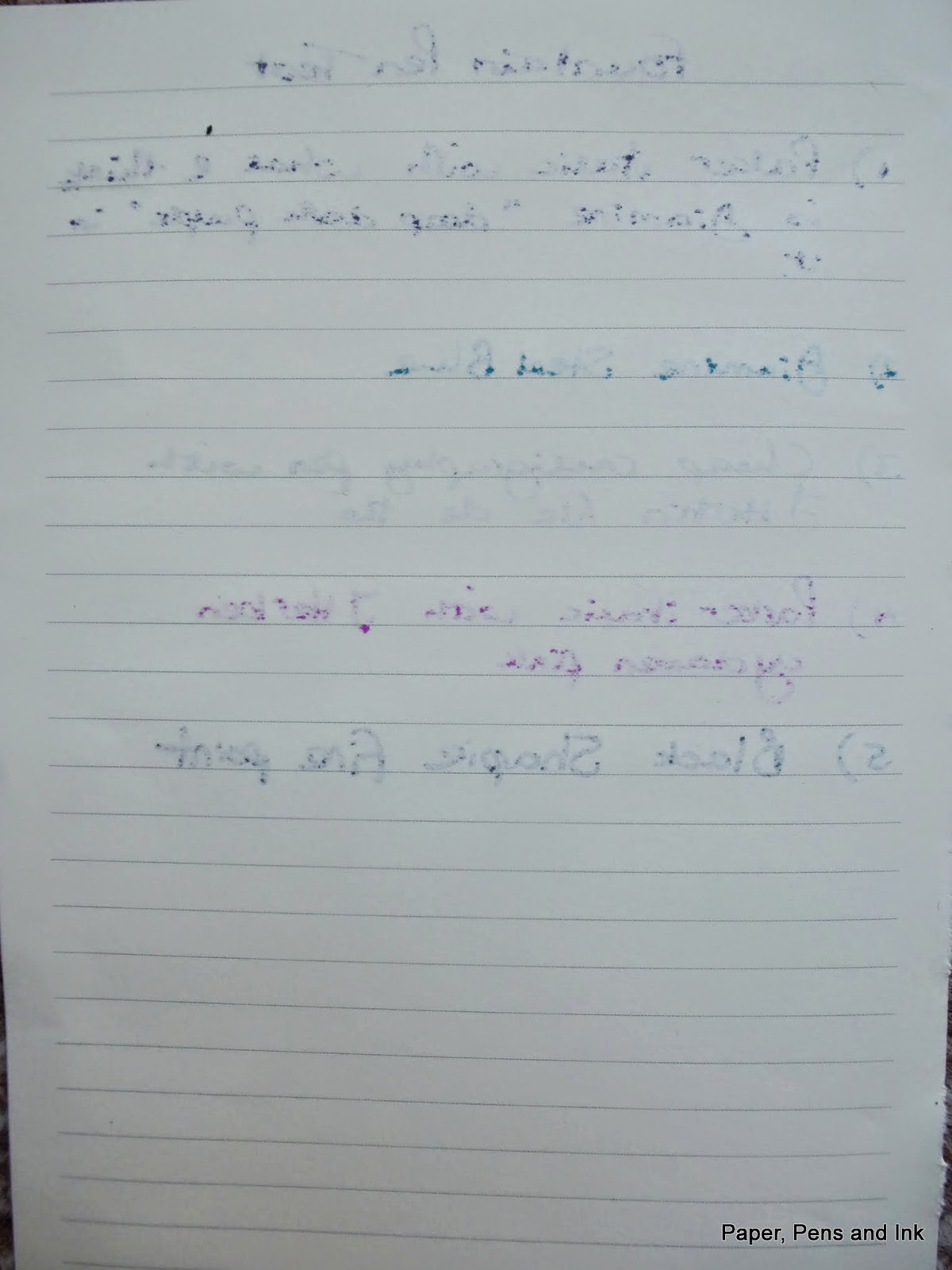
Almost no bleed-through. When I first did the test I thought there was none at all, but there is a smidgen. It’s better than the Leuchtturm books but still not as good as the Clairefontaine Age Bags (what is??).

...no bleed-through

Overall:
Hmm. Only 3 ½ (out of 5). The paper is delightful to write on, but they are more expensive than my go-to Clairefontaine A5 Age Bag notebooks (about twice the price) and without many more bells and whistles. And that bold line is more irritating than I thought it would be (though it might grow on me).

Sunday, 25 May 2014

Review of the Leuchtturm 1917 notebooks

New Leuchtturm 1917 notebooks
I have SO many reviews owing. Let me begin to make amends and review the Leuchtturm 1917 for a start – I bought two of them in The Paperie’s 3 for 2 sale (the 3rd book was the Paper Thinks notebook, reviewed here). No affiliation - just a happy customer.

Overview:
The Leuchtturm notebooks are nicely designed books in my opinion. They have hardback covers (in a series of bright, cheery colours), with ivory/cream paper, numbered pages, a table of contents at the front, detachable pages at the back, an expandable pocket in the back, matching ribbon marker and a vertical elastic closure. The paper is lovely to write on. Notebook size is 208mm x 147mm. There are 249 numbered pages.

Detail:
The Cover:

I bought two – an emerald green cover and a berry red one. I have only opened the berry red (I assume that the innards of the emerald green one will not differ significantly!). The colours are vibrant and intense and a welcome cheer on a rainy May weekend up here in Scotland!

Back cover

The cover is PVU with a leather-effect and no plasticky smell, thankfully. There is no branding on the front or on the spine, and just ‘Leuchtturm1917’ embossed on the back. The cover is rigid.
As a comparison with other notebooks/my filofax, here is the emerald green next to a Sea Green Cartesio notebook...

Leuchtturm on the left, Sea Green Cartesio on the right

... and the berry red next to my pink Baroque filofax...


Inside:
The first page has a space for name and address. Personally, I would prefer just to have the lines and no instructions over what should go there, as I don’t put either my name or my address in most of my notebooks as they never leave my house.

Name/address page; booklet on the left
 There was a small card saying ‘thank you for buying this product’ inside and a leaflet about the notebook and the history of Leuchtturm. There was also a set of stickers for labelling the books (though personally, I have never used these and think they would detract from the exterior of the notebook. I might use one on the inside).

Stickers

After the name/address page is a blank fly-sheet, then there are three pages of index.

First index page
Then a double spread of them

This is followed by a blank side (the reverse of the last index page) then the main notebook.
At the top of every page is “Datum/Date:” and at the foot of every page on the outer corner, is the page number. I like this, as I always number my notebooks and I always produce a list of contents at the start of the book, so for me, this detailing is a bonus. I’m not so convinced about having the date at the top of every page – that might grow on me!


The paper is ivory/cream, with a line-spacing of 6mm. The lining is feint (very light, actually – I like how subtle it is!). The lines go edge to edge of the paper and there is a top margin of 12mm and a bottom margin of 7mm. The outer corners are rounded.

The last few pages of the notebook are perforated so you can remove them (I removed the last page to test how easy this is and also to do the fountain pen tests). Initially, the idea of the last few pages being removable hadn’t appealed, but in fact, these are very subtly perforated so it isn’t obvious that they are, nor would it be easy to accidentally remove them, so if you didn’t want to take out sheets, the book would stay intact. The perforations are incredibly fine and the paper came out okay (though it was a bit of a tug to get it started).

The back, expandable pocket covers the entire back cover and is pretty gusseted – you could cram a lot in here if you wanted to spoil the look of your notebook!!

Pocket in the back. (the white thing on the RHS is the book label)

The ribbon marker is a good match to the cover and to the elastic closure (yes, we all know how picky I am about these things!). It is a relief that this all matches so well on a notebook whose strap-line is “Details make all the difference”!

I personally prefer a horizontal elastic closure so that I can tuck a pen in to it, but if you wanted to carry a pen, Leuchtturm do matching adhesive pen-holders and you could stick one to the cover very easily.

Fountain Pen Tests:
Again, I don’t have as many inked up as normal. I used three italic-nibbed pens (by far my favourite pens to use) plus one standard nib plus a couple of Pilot V5 pens.
The paper was a little bit ‘grabby’ on the italic pens and made them feel a little scratchy, but the non-italic nib flowed smoothly over the page and it was a dream to write on with it. The two Pilot pens were okay (but not my favourite to write with anyway). There was no feathering and ink dried quickly, so lefties would be absolutely fine (assuming my inks are representative).

Crisp - no feathering

Bleed-through:
Hmm. A little disappointing considering they go on about ‘ink-proof’ paper. I could read everything on the other side of the page very easily. I’m not sure if I would want to use fountain pen in the books as a consequence. Maybe. I was expecting better though.

This is looking better than the reality...

Overall:
Gorgeous colour cover and well thought out interior. Good little notebook and one I am sure that I will use for book-plotting/writing. It’s just a shame that there was so much bleed-through with my fountain pens and that the page is a bit grabby on italic nibs.

I would award it **** (out of 5)

Saturday, 24 May 2014

More stationery goodies!!!

Having succumbed to the three for two notebooks at The Paperie, I then succumbed to the 20% off everything sale at The Journal Shop.

What arrived today:
  • Midori MD Notebook (A5, ruled)
  • Large red Moleskine softback notebook (ruled)

Reviews soon!!

Friday, 16 May 2014

New notebooks

New notebooks!! Hurrah!
I know. I need more notebooks like I need another pair of legs or something. But hey. The Paperie were doing 3 for 2 and I just can’t resist. I’ve tried. I really have. But it only lasts about a second and then, somehow, there are three notebooks in my basket and there we go.
(No affiliation, just a happy customer)

Anyway, sorry for the long silences but a) work got busy, b) writing got REALLY busy and c) I went to Malawi again.

But now I’m back and buying more stationery! (Plus ça change!)

What did I get??

Well, the A5 notebook that I am currently writing book #6 in (Ciak, red A5) is suiting me as a size just brilliantly, so I decided I could try out a couple more. I’ve never tried the Leuchtturm 1917 before, so I popped a couple of those in bright colours (berry red and emerald green) in the basket and I had never seen the notebooks by ‘Paper Thinks’ before so I popped in one of them (in blue mist colour).

Paper Thinks first; Leuchtturm another day...

Overview:
The Paper Thinks notebook isn’t a true A5 – it is a little smaller at 13cm x 17cm. The cover is apparently recycled leather (and there is indeed a leather smell to it if you hold it right up to your nose!). The outside is much glossier than leather normally is (though isn’t patent leather). The cover is fairly stiff so you would be able to write in it with the book on your knee etc.
There is very little branding – the front cover is entirely blank; there is Paper Thinks on the spine in a darker blue than the cover and ‘recycled leather’ embossed in the back. The notebook says that it was made in China.

Front cover (still wrapped)
Back cover (still wrapped)
Front cover (unwrapped and now inside as it got really windy!)
Branding on the spine

Inside:
On the inside left cover there is the Paper Thinks logo and web address, and on the RHS there is space for name, phone and ‘in case of emergency’.

Inside

The paper is ivory/cream; the lines do not go edge to edge, but stop 6mm from the outer edge and 8mm from the inner edge. Top margin is 12mm; bottom margin is 8mm; line-spacing is 6mm. There is no elastic closure (either vertical or horizontal) but there is a matching ribbon place-marker. There are 256 pages.
The pages are sewn in and this should make the book lie flat, but it doesn’t (as evidenced by the paper-weights!). With a bit of bending and flexing it’s not bad though.


Back cover:
The back cover has a gusseted envelope/pocket (easiest way to photograph it was to put the paper-weight inside it!) with the gusset made of matching fabric.

Back gusseted envelope/pocket

Fountain pen test:
Hmm. For once, I don’t have many pens inked up! But, I had four and a Sharpie, and here are the results:
The paper is pretty smooth to write on and there was very little feathering.

Fountain pen test
Little feathering
Slightly more feathering with the pink

However, the bleed-through was an EPIC FAIL!
Read it and weep.

EPIC FAIL!

Which is such a shame as otherwise it was a lovely little notebook, but it is now one which will at best be a ‘scribble’ book or a ‘biro only’ one.

Overall:
It’s a nice size. Not quite a true A5 but a reasonable size and aspect ratio combination to be honest. At the 3 for 2 offer, I got all three (the two Leuchtturm and this) for £25.49, making each book £8.50. Expensive enough to be nice; cheap enough (at this price) not to be too precious over it! It’s just a shame that the bleed-through was so awful.

I award it *** overall

Sunday, 13 April 2014

Notebook or Filofax?

I have decided that I need to keep more notes for Rotary. Not so much dates of events, as these go straight into my diary, but notes on the talks given, the projects we are working on etc.

But, the questions is, do I go for a notebook (of which I have zillions) or a spare filofax (um, yeah, same thing about the zillions). On the one hand I want something fairly small and neat, but on the other it would be nice to go for something where I can file the pages under different dividers.

As everyone knows, I have a small shop’s worth of notebooks (and filofaxes) so there MUST be something in there to use!

The Options
Having had a look through The Emporium and The Bottom Drawer of my Desk, I have whittled it down to:

  • A Cartesio notebook (13cm x 21 cm)
  • The pocket flex
  • A pocket filofax filled with notepaper which I can transfer to another binder later and file under different topics
  • A personal filofax filled with notepaper which I can transfer to another binder later and file under different topics
  • A homemade “Midori Traveller” (either with A6 size notebooks in it (by Papelote) or a slightly smaller Field Notes size – I have made both!)


Pros/Cons

The Cartesio
Pros
Cons
Lovely notebook
Not possible to file things separately – continuous book
Lots of great colours
Perhaps a smidgen too big (it has a bigger footprint than my filofax but is thinner)
Good page size

Hard cover so easy to write on out and about


The pocket flex
Pros
Cons
Small and neat
A bit small
Possibility of having different notebooks for different things in the same cover
Horrible paper
Possibility of tearing the pages out and filing them in one of the many unused pocket filofaxes


Pocket Filofax
Pros
Cons
I have lots not in use and would really like to use them
Page size is a bit small
The small ring size would (for once) be a bonus!

I could transfer notes to another unused one (therefore using two!) to file notes


Personal Filofax
Pros
Cons
I have some spare one, not being used
A bit too big and heavy
Page size is about right

I have lots of spare notepaper for them

Pages could be transferred to another one for filing


Homemade “Midori Traveller”
Pros
Cons
Small and neat
Floppy cover
Possibility of having different notebooks for different things in the same cover


If I win a very slimline binder on eBay that I’m looking at then my decision might be made. I would load that up with cotton cream paper and transfer notes to the navy Portland once they were ready for filing. The one I am looking at is very, very slimline (the ring diameter looks like it is less than 10mm!) so it wouldn’t be a giant brick to carry.

If I don’t win it, then I think it will be a close call between the Cartesio and the homemade “Midori”

Keep you posted!

Friday, 11 April 2014

Review of Midori Dainel notebook

The Journal Shop did a 20% off everything offer. Despite all the urges to the contrary, I managed to restrain myself and only bought three notebooks: 1x Midori Dainel A5 (blue cover) and 2x Moleskine soft cover in black (19 x 25 cm – who knows what size that relates to??).

I realise I have never actually reviewed the first Midori Dainel that I bought (purple cover), so let me waste no more time before doing so.

General:
The notebook is a collaboration between Midori and someone in France who makes the cover (who?? Anyone know?) The name ‘Dainel’ means ‘suede’ in French and refers to the cover, which is both coloured and textured like suede. The paper is thread-stitched so that the book will lie flat (with a bit of help); the paper is by Midori. There are 91 pages (presumably it was 92, but it counts 91 because they have ‘stamped’ on one of them).

Cover:
The cover is card, though it is printed to give it a suede-effect look. There is a plastic cover on the outside (removable) with information printed on the back inside cover:

Covers (Still in plastic)
Information panel on inside back cover

I took the plastic covers off and took another picture:

Without covers

Hmm. I’m not convinced I like the feel of the book with or without the plastic cover! Without is a bit better (it feels like the board in Fuzzy Felt if anyone else is old enough to remember that!). The colours are lovely though.

The bottom left of the front cover (right next to the spine) has 'Dainel' embossed in it. Very discreet!


Inside:
There is a ‘stamp’ printed on the first sheet:

'Stamp'
Reverse of the 'stamped' page

Paper:
The paper has lines that don’t go quite to the edges of the page and the ‘lines’ are in fact very closely spaced dots. Line spacing is 6mm. Colour is cream.

Ink test:
Given that the ‘stamp’ from the front page bleeds through so much, I had some trepidation over the ink tests. I did the ink tests on the ‘stamped’ page and turned the book upside down as there was no major reason to indicate that it was ‘the wrong way up’ (the top and bottom margins are the same). I also didn’t want to waste a page doing ink tests when one was already wasted with the ‘stamp’!
Generally, there was no feathering at all. Ink took a while to dry (depending on brand) and there was some bleed-through (though pretty acceptable). The paper is quite thin, though this might be still the same weight as other papers, just rolled/compressed more to make it thinner. I currently have fewer pens inked up than normal, hence the reduced test.

Ink test
Ink test - reverse

Overall:
Nice, slimline notebooks. I’m not sure what to use them for as they aren’t quite thick enough for book-plotting, but no doubt it will find a use eventually!

Best laid schemes...

...gang aft a-gley indeed!

A week ago, I thought I would go back to time-boxing and instead of trying to plan tasks, plan time on projects (and if a task reached completion, I would, of course, tick it off the list). I thought I had 11 ½ free days up to May 4th and I guesstimated 8 hours/day of usable time and drew up a plan on how to spend the hours on different projects.

Oh dear.

Almost immediately it all went wrong.

I found out that I am back to Malawi on the 2nd May, neatly removing some of the days I thought I had. Not only that, but ‘stuff to get done before I go to Malawi’ then started to impinge on other remaining days (sorting out travel medicine seems to be taking up a ridiculous amount of time!).

Then came a couple of unexpected events, taking some more time chunks.

Then came the 8 hours a day issue. I had evidently forgotten that my first day ‘off’ after work (I work part-time) never seems to involve me having my backside in the chair ready to write/edit first thing. I am always slow to get the day started (whatever it is I have planned) for some reason. 8 hours in the day to do stuff? Er... no.

Then came a huge heap of ‘unexpected tasks’ which were either more important or more interesting to do than what I had scheduled. More slippage!

Then came that rebellious tendency I can have. I saw my day carved up into boxes and thought, nope, not doing that.

Then my head intervened with its ‘yes, I know you were just scheduling time and trying not to get swept up in a task, so that other things would get completed, but you’re only 5 pages away from editing the whole of this chapter, so why don’t you just finish it?’ and of course, I did.

It was also pouring with rain so gardening got crossed off the list.
I wasn’t well so running got crossed off the list.

In the picture below, I have my planned day on the LHS and the reality of the day on the RHS.

Let’s just try this all again shall we????

Monday, 31 March 2014

Oh. It seems that I’m NOT Superwoman

Huh. Who'd have guessed?

This bolt of enlightenment has come about as a result of doing my monthly review and Q1 review, where I am steadily noting all the things I haven't managed to do from my list of 'next actions' for March and/or Jan-Mar. Partly, this is because I have decided to change the priority of some goals (um, because I wanted to do them more than the other things... like writing book 6 instead of editing book 5; doing anything other than housework). Mostly it is because I have been singularly inept at remembering that I can only spend a minute once.

I hate not being able to tick off things I have achieved, so I am going to try two things for April: allocating time to projects (rather than allocating 'next actions') and returning to time-boxing.

Most of my projects have 'next actions' that are in themselves pretty concrete ("Finish editing book 5") but which can take elastic amounts of time depending on whether my head is in editing mode or not. Some days I can clear the scheduled pages easily; other days it is a real slog. Also, book 6 is bubbling away too vividly to ignore, and if I spend an hour making notes on that, there is an hour less to spend on editing. Likewise, "Tidying the garden" has technically got a concrete end-point (the garden is tidy) but we all know that that scenario is unreachable!

What would be much easier to monitor (and hence feel like I have achieved something) is to allocate time to these projects. Instead of "edit book 5 up to page 300" I will "spend X hours on editing". Similarly, instead of "tidying the border by the lawn" I will "spend Y hours tidying the garden".

The added bonus for this is that it will make me look at how much free time there is in my schedule and be sensible about what I can achieve in it. If there are no free days in a week, it would be impossible to have edited 40 pages of book 5, weeded a large border, planted lots of seeds, finished my report for Rotary, done the housework, read at least one book and written to four friends by the end of it, yet sometimes my weekly 'to do' lists look like that!

Time-boxing has worked well for me (see here) but often ends up failing because I've allocated tasks to the time rather than just allocated the time to a project area. Since I'm ludicrously poor at estimating 'time to completion' on tasks, things have crept into other time-slots and I've ended up feeling over-scheduled, at which point I abandon everything and end up doing nothing.

So, for April, I counted up how many free days I have and converted that into free hours. Then I looked at all my project areas and allocated time to them, rather than tasks.
[Oh, and I made sure that I scheduled time for: catch-up/unexpected things/"mosquito tasks"*]

I have 11 ½ 'free' days in April (yes – this is why you overestimate how much you’re going to get done – you have fewer free days than you think!). Allowing 8 hours per day (possibly an underestimation, but better that way than the other...) that gave me 92 hours to allocate to projects. [I realise this is ignoring evenings which are also technically 'free' and in which I could probably achieve heaps, but I would rather under-allocate and over-achieve than vice versa]

I then started to guesstimate time on an hours per week basis to: Chimwemwe work, writing (encompassing editing and sketching out book 6), writing to friends, running, gardening, housework, reading, and emerging tasks/"mosquito tasks" and quickly clocked up about two hundred hours! Whittling it down to 92 has made me be far more realistic over what I might achieve in April and how many hours per week I will be able to spend on each area!

Having produced my 'hours per project' list for the month, I then spread out the hours per project area over the weeks for April (actually, up to May 4th as I work in Monday to Sunday blocks). I have to say, using a spreadsheet kept me right as I invariably pencilled in more hours than there were free that week and had to start horse-trading with the project areas: a little less of this so I can do a bit more of that...

This up-front effort will hopefully make my weekly/daily scheduling a whole heap easier, as now I just have to time-box the hours for the week into a diary (and use my sand-timers on the day to keep me right). If I manage to achieve a 'next action' I will of course tick that off on the main lists, but if I don't, at least I will have progressed towards it.

Thank heavens for Philofaxy, since as I am back to time-boxing, I need a day per page diary, but as I am trialling this method, I only need a month of it, and can just print off the requisite pages from the diary files. Bless you Steve and Ray!

As well as writing down what time I intend to spend on each area, I am also going to note down how much time I did spend on each area so that May's list might be based on a tad more evidence (I am a scientist after all...).

I'll keep you posted as to how it's working (and show you pictures of the system in progress!).

[*"mosquito tasks" are small, irritating things that don't warrant an individual slot for each task, but which can be lumped together into a 'do all those irritating little things in this hour' slot]

Monday, 17 March 2014

In praise of the A5 Domino (2)

In my last post, I wittered on about how many A5 dominos I now have, but what keeps bringing me back to them so often?

1. The price
They are frequently on offer in WH Smiths with either 40% or 50% off. (No affiliation, just always had good service from them. I have bought every single A5 domino I own from them!)

2. The 30mm rings
Huge. Just huge. And since I am generally not hefting these binders about on a daily basis, the fact they have huge rings and are stuffed (and heavy) doesn’t matter.

3. The rigid cover

I may well be using these to make notes whilst out and about (not all that common an occurrence) or whilst balancing the binder on my knee (much more common occurrence!) and the rigid cover makes this an easy task.

4. Pared-down interior

I am largely using these as binders and never as wallets and so the pared-down insides work well. The notepad slot in the back is brilliant.

5. Two pen-loops; both elastic

I surely don’t need to explain any further do I?

6. The fill

Although I bought this to use with home-made contents, I still like the fill it comes with. The one I just bought had an academic diary (July 2014 – December 2015; week to view, vertical) which will be used in 2015; A-Z dividers (okay, I’m more ‘meh’ about this as I have about a zillion sets of these now!); several sheets of coloured paper; some address sheets (okay, fairly ‘meh’ about these too); some ‘to-do’ sheets; a top-opening envelope; a ‘today’ marker’; a note-pad.
The address sheets and dividers are no use to me, but the rest of the fill is pretty good, especially the note-pad, which unlike the atrocious diary paper, handles a fountain pen okay!

For the price (£22) I think this is a great deal!

Saturday, 15 March 2014

In praise of the A5 Domino (1)

I'm either addicted, or they are breeding.
I counted how many I have (sad but true). I appear to now possess six of these things (having bought another red one, reduced price, from WH Smiths - £22).

Six???
Indeedy. Four red and two ultraviolet.

Er... why so many? What are they used for?

Two are used as ‘book-o-fax’ binders
One is a letter-writing binder
One is a ‘me’ binder
Two are writing binders: one for admin; the other as a book-planner

Book-o-Fax (2x red)
I have an ever-growing set of book reviews. I only started doing these in 2009 but am now having to move to a second volume (the reason that I needed another new A5 domino from WH Smiths!). I keep a list of all the books read in a particular year (not including things read for work) and also a review of each of them. I use a set of A-Z dividers to sort the reviews by author. This post describes the book-o-fax.

The Letter-Writing binder (red)
I write a lot of letters to friends. I love getting a hand-written letter in the post and I enjoy writing proper letters to people too. In the letter-writing binder, there are envelopes, letters from people in the filopal set-up, notes that I have made on what I have written about to people (so I don’t keep repeating myself!) and in the note-pad slot in the back is a block of writing paper.

The ‘Me’ binder (ultraviolet)
Other than a print-out of an e-book, this is disappointingly rather empty! There are a few notes I made whilst reading through a few ‘change your life’ type books and some things cut from magazines or papers etc., but I really should use this a bit more!

The two writing binders
1. Writing admin (red)
This houses notes for blogs, story/novel plans, notes on agents, which of my books are at what stage, research notes for magazines etc. As I say, general admin. I posted about it here (though the set-up has changed a teensy bit since then).

2. The book-planner (ultraviolet)
I used this one to plan the last novel, but then switched to a bound notebook. I blogged about it here, here and predominantly here. I still hum and haw about using it for book-planning but then I always prefer using a bound planner (even though I know that using a binder is more sensible in so many ways!). I might use this as a book-planner again for book 6 (which is currently getting scribbled about in a Ciak notebook, but once I get more serious about writing it, I might move into the binder). If I don’t use it as a book-planner, I may start to store character notes in it. Every character I write about gets a ‘character dossier’ and I might put them all in one place (either organised by novel or by character name – not quite sure which would be better).

So, that's why I have six of these things! Anyone else have multiple versions of the same binder (domino or other)? What makes you keep buying them? And what do you use them for?