Saturday, 18 January 2020

Stalogy cover

In fairness, I didn't really need a cover for my Stalogy as it wasn't going to be anywhere other than my desk, but... well, you all understand!

I had a browse on Etsy and found a seller who made plain, simple leather covers. I don't need any bells and whistles for the cover, just something sturdy and nice. Anyway, the seller was whpdesign and they do a range of colours/leathers etc.

I ordered a brown leather cover:

Front
Back

Friday, 17 January 2020

Stalogy 365


Sorry for the LONG delay in posting. I've been up to my neck in editing and that has stolen all my time! There may be some light at the end of that tunnel in March.

Anyway, for 2020, I decided that my journal would be a B6 365 by Stalogy. I've used various diaries (as journals) over the years and fancied something a bit different.

For those of you who haven't come across Stalogy yet, they make a series of excellent notebooks. Some of my favourite B5 writing notebooks have been the Stalogy 016, but the 365 series is a little different. They come in a variety of sizes (B6, A6, A5) and the A5 come in different coloured covers and also a half-year option.


They are simple little things. There is little branding on the front, no 'bells or whistles' (so, no ribbons, no back pockets, no pen loops...), just some great quality, super-thin paper. The B6 and A6 sizes have 0.5 mm squared paper; the A5 has 0.4 mm squares. In both cases, the squares are in such a faint grey, you could probably ignore them if you so chose. At the top of each page, again in very faint grey (and in almost microscopic font) there are the days of the week, the months and the numbers 1-31 so you can circle them to note the date. Down the left-hand side of each page are time points. In the B6 they go from 7 in the morning to 11 at night. In the A6, the times go from 8 a.m. to 9 p.m. (I don't know what the layout is in the A5 as I don't have one). Again, this is so faint and in such a small font, you could easily ignore them if you didn't want to use them.


Some people think of them as a cheaper Hobonichi, but I think they are very different beasts. To me, the Hobnichi has a lot of duplication with monthly, weekly and daily spreads. I don't find the layout of the Hobonichi very flexible, either. I think the Stalogy wins for me because it can be used as a day-per-page diary (as I am - see below) or as a bullet-journal, with whatever layout you want. The lines and notes are so faint, they can be ignored, but are there if you do want to use them. They're also a lot cheaper at ~£17 (for a 368 page books - not bad!). I like the B6 size -  big enough, but not too big.

How I'm using it...
I have a time-log on the left of each page and my journal entry for the day on the right. I'm also trying to use more colour and decoration than I usually do, though this doesn't appear to come naturally to me! Along the bottom of each page I'm logging various things, but they're too personal to share - hence the image being trimmed.


I've also bought a cover for it... more on that in the next post.

The paper is super-thin, but takes most pens well. There is a bit too much show-through/ghosting for me to want to use a fountain pen in it, but that's because I have a huge aversion to ghosting.

So far, I'm really enjoying using it!

Anyone else out there a Stalogy 365 lover? How do you use it?

Sunday, 1 September 2019

I've bought my 2020 planner...

... and no major surprises but it's by Box Clever Press again and is the 2020 version of the diary/planner I've been using all through 2019.

Last year, I found the perfect layout and planner for me and I was worried that either the company wouldn't make it again or would fiddle with it so that it was no longer just right. I'm delighted they haven't!

So, why is it so perfect for me? As I said last year, I have a LONG list of 'must-haves'. I need a diary that:
  • is about A5 size
  • has a week to a view with the days in vertical columns (so I can time-box)
  • has equal sized columns for Saturday and Sunday (my life isn't less busy, just because it's a weekend!)
  • has the week starting on a Monday (who in their right minds splits the weekend so that it bookends the week? It's a weekend)
  • has space to list tasks for the week
  • preferably also has space to list Most Important Tasks for each day
  • would help me with planning my week/month/year
  • preferably is pretty/attractive because I have neither the time nor talent to do it myself but like the look of them
  • will lie flat on the desk
  • preferably has 2 ribbon markers, but at least one
The Box Clever Enjoy Every Day A5 diary ticks all the boxes. Yep. Every single one! Here's a (picture-heavy) walk-through...

Thursday, 15 August 2019

Cambridge Imprint notebooks

Notebook samples from Cambridge Imprint
Recently, I was asked by Cambridge Imprint to review a couple of notebooks. I should hasten to say, these notebooks are not currently available to buy from them - they were prototypes which they wanted feedback on.

I have a number of Cambridge Imprint notebooks (yes, I know, I haven't reviewed any of them on here yet, but I will). I have a large square softback notebook and a set of three pocket-size notebooks. I really loved the look of their stuff, but wished they did a lined notebook that was bigger than the pocket size, but not as big as the square one. They do have medium-sized notebooks, but they were all plain, not lined. I contacted them about whether they had any plans to produce a lined one, and they sent me these two books to have a look at! They are the same size as the plain ones (18.5 cm x 12 cm; paper size: 18 cm x ~11 cm).

The two they sent me were covered with the Letterpress Harebell paper, and the Elephant paper. There's no plastic (hurrah!) and the papers are absolutely gorgeous!

Elephant paper

So, what do I like about them and what don't I like?

Loves:

Well, I love the covers - the papers are all amazing (have a browse of their site and see what glorious papers they have). They're hardback so will resist all but the most significant dings. There's a small label on the front to indicate the contents, which is a lovely touch.

Letterpress paper

The paper. I've only used fountain pen in them (and I took out a page to do the tests, as I don't like leaving them in). The paper is fairly toothy, so would work well with pencils too. Writing wasn't as smooth as in a Clairefontaine book, but was a nice experience. My sharp calligraphy nibs jagged a little, but they jag on everything except Clairefontaine! The stubs were great and regular nibs were fine. There was some good shading going on as dry time isn't super-fast (lefties may need to take a little bit of care). There was no feathering, bleed-through or show-through.

Front
Back

Size: Not so large that they would take up too much real-estate on a desk or in a bag, but big enough that you're not starting a new page every second. At a page size of ~180 mm x ~110 mm, they're fairly close to B6 (which is 176 mm x 125 mm).

Ruling/margins: They're pretty narrow ruled, which suits me (even with a chunky nib) but if your handwriting is large, you might struggle. Ruling is 6 mm, with a top margin of 15 mm and a bottom margin of 9 mm. 7 mm might appeal to a wider range of people? As I say, they're fine for me!

Things they don't have, but I don't care:

There's no contents page, page numbering, page markers or a pocket in the back cover. None of these things are deal-breakers for me. If I need page numbers, I'll add them in. If I want a contents page, I'll leave some blank pages at the start/end. I rarely use the back pockets - they can make the writing experience a bit lumpy.

Things I'm less keen on:

The first and last page are glued to the end-papers and there's quite an overlap. I'm never keen on glued spines, because they're hard to open the book out flat, and this is the case here too. I'd rather they would fall open properly - writing in the inner pages will involve a bit of brute-strength!

I hope that they'll make these part of their main range as they're just beautiful!

Saturday, 10 August 2019

Life A5 notebook

As Stu says over on Nero's Notes:
Life notebooks are coveted by anybody who values quality paper. The Noble line of Life notebooks in particular are beautiful, featuring Life's superb fountain pen ink friendly Japanese paper, which is cream in colour and finely laid. As you would expect, the paper in the Life Noble notebook is acid-free and archival quality. This A5 sized notebook comes in plain, ruled and graph paper (5mm grid paper and 8mm ruling) and features the LIFE logo, embossed in gold. 
I've been using a ruled Life notebook for making notes on the gazillion things I need to think about/do/investigate ready to self-publish my fantasy trilogy later this year. I'd been umming a ah-ing over which notebook to use (something I suspect only stationery nerds like me do, because we have so many notebooks to choose from...), so let me share my reasoning for why I plumped for the Life notebook over the other million I have in my stash.
Well, first up, the paper is fountain pen friendly. I realise that many people won't care about that, but if you do care about that, you generally really do care about that. A paper that feathers or ghosts or lets the ink bleed through to the other side drives you insane. But, even if you don't give two hoots about this kind of thing, if a paper is good for fountain pens, it's generally amazing for any pen. Or pencil.
The paper is thick enough that there's minimal show-through and there is no feathering at all. Dry time is a little on the long side, so lefties may want to think about that, and you may want a sheet of blotting paper handy too.
My only niggle with the paper is that it's a yellowish cream and I prefer off-white or a light ivory, but that's just a personal preference.
There are 100 pages (sides) in the book. This is a happy medium between the slimmer notebooks available (68 or 72 etc.) and the chunkier 168+ page books. I'll have a lot of notes to make, and a slimmer book will probably be too small, but I hate waste and it would annoy me if I only used half of the pages in a larger notebook.
But one of the things I love the most about these notebooks is this:

The little dots at the top and bottom lines. These are perfect for if you want to add a table, because you don't have to faff about measuring it out. Fear not, the marks are small enough that if you're not needing to draw out a table, they won't distract. They're spaced at 10 mm (which a bit of my brain sometimes squeaks at because line spacing is 8 mm, so drawing vertical lines leads to rectangles, not squares).
Since I'll be making notes on a variety of sub-topics in the book, I'll be putting a table of contents at the front (and may even put an index at the back!), and there may be a number of topics where being able to quickly draw a table is a bonus, for example when I'm comparing different editors or cover-designers.
I also like the top margin with a slightly darker top line. The top margin is 15 mm and I use the space to put a few-word summary of the page contents (like 'print on demand' or 'keywords') so that when I flick through the book I can see what's on each page.
There are no fancy frills like ready-printed page numbers (I've just hand-written them in) or a ribbon-marker or a pocket in the back, but this is a good, solid notebook at a very decent price. Why don't you give it a whirl?
A modified version of this post first appeared on Nero's Notes.
*The post contains affiliate links, which help me to be able to run this blog, at no cost to you.

Saturday, 13 July 2019

Guest post: Pens for New Writers – What to Look for in a Vintage Pen

I'm delighted to share this post with you from Simon Gray of Battersea Pen Home on the history of fountain pens and what to look for in a vintage pen. You can find out more about vintage fountain pens and fountain pen repairs at Battersea Pen Home.

Battersea Pen Home have specialised in servicing and repairing pens, ballpens and pencils since the mid 1990s. They were originally based in Battersea before moving to Epping in 2000.

They look after most makes of fountain pen including those now classed as 'obsolete' by their manufacturers. They were trained by Parker and Waterman back in 2002 as service technicians for their writing instruments and are also recommended by Sheaffer UK.

Pens for New Writers – What to Look for in a Vintage Pen

Many people buy vintage fountain pens because they find them inspirational. In a similar way that driving a classic car can force you to drive differently, using a fountain pen forces you to write differently. Writing with a pen is more challenging than using a word-processor; you can’t easily edit what you have written and so you have to find creative ways to make it work.

When buying a vintage pen, most people are initially drawn to how it looks; although how comfortable it feels in the hand and how smoothly it writes are what ultimately determine how much it will be used. Often the most important consideration is sentimental. Owning and using a pen that brings back memories of loved ones gives a sense of connection to things past and present that a biro or keyboard can never achieve.

Most vintage pens are susceptible for wear and tear, but don’t be put off. Most of the important components can be replaced and repaired, and once refurbished, pens can continue to work for many years with very little further intervention. Here are some tips for selecting the perfect vintage pen.

The term ‘vintage pens’ covers just about every instrument produced for the purpose of making marks on slate, skin, parchment or paper. One of the first pens capable of holding its own supply of ink was described by Nicholas Bion, a French instrument maker and author who lived in Paris around the turn of the 18th century. Little progress was made until the early 19th century when the number of patents connected with fountain pen design began to increase as new materials and production processes were developed.

By the late 19th century much progress had been made with the development of hard rubber which was cheap, resistant to chemicals ink and could be easily turned on a lathe into caps, barrels and nib sections – the main components of a pen. At this time, virtually all fountain pens were ‘eyedroppers’ where the ink was contained directly in the barrel rather than in an ink sac. Ink was transferred from the barrel through the feed and onto the paper by capillary attraction; hence ink only flowed when the nib touched paper.

The 1900s saw the development of the feed (the part below the nib) in an effort to regulate ink flow. Once this had improved, designers were freed up to focus more on the portability of pens with the 1910s bringing pen caps which screwed securely onto the main body of the pen rather than just being a push or slip-on fit. Screw-on caps meant it was safer to carry a pen in your pocket so the next stage was a multitude of clip designs to ensure the pen didn’t fall out of your pocket. Everyone today takes clips for granted, but in the 1920s a fountain pen clip was quite a new idea and frequently an optional extra at additional cost.

At the same time, progress has been made with improving the method of holding ink. Rather than the hard rubber barrel being the only reservoir, latex rubber ink sacs became available and reduced the possibility of leakage. Research and design then turned to filling methods with Conklin leading the field with its Crescent filler in 1901 and Parker developing a button filling system in 1914 which was still being used on their Duofold models as late as the 1950s. Sheaffer, Waterman and others focussed on lever fillers which again lasted through to the 1960s with several companies.

So, we are almost there with what most people would recognise as a fountain pen in terms of controlled ink delivery, a variety of filling systems and a basic design which was secure enough for the pen to be carried around in a jacket pocket. The final step was in materials development. Up until the 1920s, pens were made from metal (either solid or plated gold, silver etc) and vulcanised hard rubber which restricted the colour of pens largely to black, red or a combination known as a rippled finish.

All this changed from around 1924 with major developments in the manufacture of plastics principally in the USA and led by DuPont. No longer restricted to hard rubber, pen makers went into overdrive with pens appearing for the first time in colours such as lapis blue, jade green, pearl and black and many other combinations.

So, in terms of choosing a ‘vintage pen’ to write with, the mid 1920s is really the starting point as choice of colour, style, filling system, nibs begin to expand almost exponentially.

Many thanks to Simon Grey for the post.

You can find out more about vintage fountain pens and fountain pen repairs at Battersea Pen Home.

Saturday, 8 June 2019

HUGE pen test on pocket size notebooks!!

This post was born out of writing a post for Nero's Notes on whether my dislike of Moleskine and Field Notes was justified (spoiler alert... it is). They really don't play nicely with fountain pens, but then I wondered which pocket notebooks actually did.

Enter the biggest test I've done yet, with 10 notebooks getting tested. I used 5 fountain pens and I also tested 11 non-fountain pens too.
Warning! Post is very picture heavy!

The Notebooks:
Field Notes
Moleskine
Whitelines
Story Supply
Word.
Rhodia Webby
Clairefontaine 1951
Darkstar
Pebble Stationery
Telegraph

The Fountain Pens:


(top to bottom)
Parker Vector with calligraphy nib. Ink = Iroshizuku Shin kai
Tombow Object m nib. Ink = Iroshizuku Ku jaku
TWSBI Eco m nib. Ink = Diamine Burnt sienna
TWSBI Diamond 540, 1.1 mm stub nib. Ink = Sailor Yama dori
Conklin Durograph, 1.1 mmstub nib. Ink = Iroshizuku Shin kai
Platinum Preppy - UF nib. No idea what the ink was and anyway, it ran out...

The Other Pens:


(top to bottom)
Pilot V5 hi-tecpoint 0.5
Uniball vision needle micro
Scheider slider memo XB
Uniball signo RT 0.7
Uniball Jetsream 1.0
Stabilo worker medium 0.5
Zebra J roller RX 0.5
Zebra Z-grip medium (biro)
Uni jetstream 0.7 (biro)
Calepino bic biro
Field Notes bic biro

The results:
A lot of pictures... left side of the picture shows the pen test; right side of the picture shows the reverse of the page.

Saturday, 25 May 2019

My Every Day Carry (#EDC)

It's been a while since I shared my set-up with you, so I thought I'd give you all a quick look at what I'm using at the moment.

I need my EDC to have everything in it. There's no point me having a separate wallet and diary/notebook, because I'll forget one or other of them when I leave the house! But, I need to have something small enough that I don't wreck my back carrying it around! I'm somewhat in awe of people who merrily lug a well-stuffed A5 Filofax or planner around with them. Despite the fact I do always appear to have an enormous handbag, my EDC is pretty small.

For a long while, I'd been using my undyed extra wide pocket from Meadowgate Leather, which is slowly turning the most delicious caramel colour. But this week, I've changed out of that and into another Meadowgate Leather cover that I bought from a Facebook group.

Pocket TN from Meadowgate Leather
with extra width

Friday, 3 May 2019

B5 bonanza!


There aren't all that many places that sell B5 (at least, not in the UK) and those B5 notebooks that are reasonably easy to get (via eBay or Amazon) are often poor quality. These ones are okay, but just don't play nicely with fountain pen.

Well, despite the fact I'm deep into editing the fantasy trilogy I've been writing for a few years (hopefully published later this year... watch this space! Or watch my author website - I'm more likely to talk about it all there!), the next book is giving me the occasional poke. And so (naturally) I start thinking about new notebooks.

I've been through a variety of notebook sizes while writing (and even dabbled with a writing Filofax at one point, which didn't work out anything like as well as I hoped it would). But at the moment, I've settled on B5 as a good size for me. Partway between A5 and A4, it offers a decent amount of real-estate without taking up the entirety of my desk when lying open. I've also renovated an old Filofax Deskfax into a B5 traveller's notebook (to use as a writing TN).

This week was National Stationery Week and The Journal Shop did a site-wide 15% off. They sell quite a few B5 books, most of them Japanese and therefore amazing paper and so I treated myself to a small (ahem) selection.

The haul:
1x Life Kappan Note
2x Tsubame Notebooks
3x Penco Hightide Notebooks (purple, black, pink)


How do they compare and contrast?

Sunday, 7 April 2019

Current set-up: diary, to do/notes, and Travellers Notebook

I haven't blogged on here for a while (I've been busy writing and editing my novels, as well as writing for Nero's Notes), but I did tell you about my 2019 diary a while back, so I thought, since we're now in the second quarter of 2019, I should update you on how it's going.

I'm pretty much using the same system that I've used in the past, but with a couple of tweaks. I have my main diary/planner, which lives on my desk and never goes anywhere else, I have a running list of 'stuff to do/remember' and I have my Every Day Carry that is usually in my handbag as it's predominantly a wallet.

Main Diary:


This is still the Box Clever Press one I blogged about. This has honestly been one of the best diaries I have ever used! I'm even using the month at a glance pages (and we all know how terrible I am at knowing what they're for!).

So, why is it so good?

Saturday, 9 February 2019

News!

Logo of a black dog with a monocle and the name Nero's Notes

Those of you who've followed me for a while (bless you!) will know that as well having an addiction to stationery, I also write books (you can see the covers in the sidebar here!). Well... I'm now managing to combine both loves as Stuart Lennon has asked me to write for the blog on Nero's Notes.

I first 'met' Stu a couple of years ago. There are quotation marks, because in fact, Stu and I haven't ever met in real life (though I hope we will one day). We were both part of a #writingchat chat on Twitter (where various writers come together via Twitter on a Wednesday night from 8-9 pm UK time, to talk about a range of topics relating to writing) and the topic for the night was writing buddies. Neither Stu nor I had a writing buddy, nor were we in any writing groups. To cut a long story short, Stu and I swapped a small chunk of writing, gave feedback to each other and have ended up good buddies ever since!

Stu is now one of my beta readers - a very select group who read my books when I'm happy enough with them I can bear the thought of someone else seeing them, but with still some work to do on them. He also shares my love of good stationery. In fact, so much so that he bought a pocket notebook company! It was originally called Pocket Notebooks, but under Stu's guidance, has become Nero's Notes. You'll have seen a number of reviews of things from there, over the last wee while (and in case you missed them, I'll pop a list at the end).

Picture of pen, paper, envelopes and ink bottle, for letter writing
Stu is also one of the friends that I write to. Yes, I still write proper letters to people, on proper paper and put them in proper envelopes, add a stamp and post them. In fact, my very first blog post for Stu is on writing letters and it comes out on Wednesday. Please pop over to the blog and check it out? It should be up after 2 pm.

If you're reading this blog, the chances are that you share my love of good stationery, so go and have a rummage through the Nero's Notes site. There are notebooks, pens, pencils, accessories and some excellent subscription boxes to feed your habit. There's some amazing stuff on there, including some things you won't be able to get anywhere else in the UK. Hopefully see you all over there!

Reviews of Nero's Notes (originally Pocket Notebooks) things:
(Each link opens in a new window)
PapioPress A6 Notebooks
Darkstar Collection
Write pocket notebooks
Rhodia Rhodiarama
New Darkstar Collection
Stationery Box (subscription)
Word. notebooks
Inky Fingers Currently Inked (sadly no longer available)
6 for £6
Leuchtturm lined slim softcover
Poach My Lobster notebook

Friday, 14 December 2018

My day to day diary for 2019

In my last post, I said how I was staying in my Field Notes sized TN from Meadowgate Leather as my everyday carry. I only need a month to view calendar while out and about, but I need a larger diary to plan my days, so am finishing up using my standard sized TN diary (that I've used all year) until the end of December.

For 2019, I'm staying in the Field Notes sized TN and using the A5 Everyday Diary from Box Clever Press.

I can spend a ridiculous amount of time choosing a diary (often time I can't really spare, but hey ho). To work well for me, I need a diary that:
  • is about A5 size
  • has a week to a view with the days in vertical columns (so I can time-box)
  • has equal sized columns for Saturday and Sunday (my life isn't less busy, just because it's a weekend!)
  • has the week starting on a Monday (who in their right minds splits the weekend so that it bookends the week? It's a weekend)
  • has space to list tasks for the week
  • preferably also has space to list Most Important Tasks for each day
  • would help me with planning my week/month/year
  • preferably is pretty/attractive because I have neither the time nor talent to do it myself but like the look of them
  • will lie flat on the desk
  • preferably has 2 ribbon markers, but at least one
Not much to ask for, is it?? You can see why I can end up trawling shops and the internet for yonks, trying to find this mythical beast.

Well, this year I have struck gold!! I've got the 2019 A5 Everyday Diary from Box Clever Press.

Sunday, 9 December 2018

Short-lived experiment!

Towards the start of October, I was wondering what to use as my diary set-up in 2019. It had been a choice between three TNs (standard, B6 and Field Notes size) or go back to a Filofax. You can see my thoughts about it all here.

I was itching to use my Field Notes size TN, but wasn't sure if I could make it work as wallet, planner and notebook.

Short answer... Nope. Well, not quite as I had thought I would.

I'd bought a fairly cheap diary to fit in it (the teNeues one... see here for the blog post on it), which had a vertical layout. It fitted in okay, though the TN ended up a bit of a chunky monkey with that, a wallet insert and a home-made credit card insert. The teNeues diary started in December, so I thought I would trial it, and see how it went (while I still also had my standard size, vertical layout, Midori TN diary to hand). I could have made it less chunky by removing the cover of the diary, but it wasn't really the chunkiness that made it not work, it was the fact the small diary wasn't big enough for me to plan my days and weeks in.

Sunday, 21 October 2018

teNeues Cool Diary 2019 Weekly diary review

I've been umming and awwing about what to use in 2019 (see here for latest witterings) and bought myself a small diary to use in a Field Notes size Traveller's Notebook. The one I bought is a 9 x 14 cm TeNeues Cool Diary weekly diary (that is how the capital letters go in the label...). I got mine in blue, but it comes in a variety of colours.

It arrived the other day, so here's my review.

Cover:
The cover is a hard cover with nothing more than 2019 in silver on the blue on the front and the teNeues logo on the reverse. The cover is soft-touch synthetic. I'm not a huge lover of that, because I'm trying to reduce my plastic/non-recyclable purchases, but it's understated and fairly classic. That said, I'm in two minds over just removing it altogether, because it takes up thickness in the binder and the pages of the diary don't need protecting if it's in the TN cover.

Wednesday, 10 October 2018

What diary to use in 2019?

I know... it's barely October! And I don't normally have things planned hugely in advance, but we have just booked our summer holidays for 2019 and I'm feeling a bit twitchy that other than scribbling them down on the 'forward planner' bit I've created on the inside cover of my current diary, I have nowhere to put them down! I don't even have a wall calendar for 2019 and I'm sure magazines (like Country Living etc) have included them with the magazines by now.

Anyway, it's got me thinking about what to use for 2019. I currently have three options, though I may throw in a fourth just for shits and giggles.

1. Keep going with my standard-size Traveller's Notebook
2. Move to my B6 Traveller's Notebook
3. Move to a Field Notes size TN
4. Go back to using a Filofax

Saturday, 6 October 2018

Poach My Lobster Notebook Review


Many thanks to Stu from Nero's Notes for sending me this notebook to try out. This is my honest review of the notebook.

Recently, I've been shifting away from the A sizes of notebooks (A4, A5, A6 etc.) and turning more often to the B sizes (B5, B6 etc.). B5 (176 x 250 mm or 6.9 x 9.8") is an excellent size for me for writing/planning books and B6 (125 x 176 mm or 4.9 x 6.9") is a great size for a handbag-notebook. The notebook by Poach My Lobster is 128 x 202 mm, or pretty much exactly 5 x 8". Although not a true B6 size, it's a pretty good size for my bag.

The corners are rounded and the paper is glued in (making the flattability score for me pretty low).


The label on the back said the following:
128 pages of Fedrigoni Arcoprint Edizioni Avorio 1.5 100gsm
Cover printed on G. F. Smith's Colorplan Claret 270gsm with buckram embossing
Books Good Enough To Eat™: designed in London, printed in Italy, made by Poach My Lobster.
The pages are blank throughout.

The Cover:
I really like the cover. There are a variety of covers available (see the full listing on Nero's Notes here). I was sent the one with the quote about wine. The colour is a dark red (my crime-writer-brain is saying the colour of dried blood, but I realise that might not be a selling point for everyone 😄). It's a sturdy enough cover that the pages are protected, but not solid or heavy. And, it doesn't appear to contain plastic (though the notebook did come shrink-wrapped in single-use plastic that I almost opened an artery trying to remove). The logo of a lobster on the back is the only branding on it.


The Paper:
The paper is lovely to write on, both with fountain pen and also pencil. It's quite toothy, so calligraphy nibs may catch a little, and the paper is matte and so there isn't much sheen to fountain pen ink (though there is shading). I quite like the fact that the paper is blank as it means I can write in it and also sketch in it (yes, I do sketch occasionally - hence the wide array of pencil tests to come!). As this is more likely to be an 'out and about' notebook (as opposed to one used for planning, or for writing books), this makes for a good combination as I can scribble down thoughts and ideas, but I can also do sketches and drawings. If you prefer lined books because your writing stays neater, rest assured that a line-card shows through pretty well, to keep you on the straight and narrow.

Pen/Pencil Tests:
As you all know, these can make or break it for a notebook with me. The pens I currently have inked would present quite a test to the paper (and many a notebook would have failed abysmally!).
This paper sailed through. No sign of any feathering, absolutely no bleed-through and absolutely no show-through, either. 'Pen Tests' was written with my Pilot Parallel pen with 1.5 mm nib - almost everything fails with this, even Clairefontaine at times! This paper - absolutely fine. No feathing or even a hint of show-through, despite the fact it's a wet pen! The paper was a little too 'grabby' for my Rosetta Mosaic, and for the Parker Italic (though almost anything except Clairefontaine is too grabby for that little pen!). Beautifully smooth with my bamboo pen (bought as cheap as chips from eBay and one of my absolute favourite pens - always writes beautifully and is so easy to rinse out!).

The pencil tests were great - there is enough tooth in the paper to make sketching fun (no slippy-slidey shiny stuff!). I'm actually really looking forward to drawing in this wee book.

Pen tests (apologies for low exposure - it's Scotland!)
Reverse of the page - no show-through or bleed through
Pencil tests

Overall:
I am very impressed. The paper is fabulous, the cover great (and quirky) and the size just right. The only thing I'm slightly less happy about is the low flattability. Maybe I'll just have to be a bit more brutal with it, but it currently does not lie flat.

Thanks again to Stu for sending me this. As I say, all views are my own and reflect my honest opinion of the book.

You can get these notebooks from Nero's Notes - click HERE to go to the full range.

Sunday, 26 August 2018

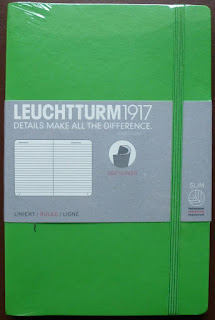
Leuchtturm lined slim softcover notebook


My good friend Stu, from Nero's Notes sent me a couple of notebooks recently. One was this little number; the other was from Poach My Lobster, and a review of that will be coming soon. Although these were a gift, these are my honest views on the notebook.

Stu knows my penchant for slightly differently sized books (see all my recent posts on B5 and B6 stuff). I find that A5 can be a little bit big for a handbag, but A6 is a bit too small for me. I've slowly been shifting towards B-sizes, using B5 for writing notebooks (see hereherehere and here), and looking at using B6 for a Traveller's Notebook (see here). So both of these notebooks were a brilliant size for me.

The Leuchtturm softcover slim notebook measures 125 mm x 190 mm (making it almost B6 size:125 mm * 176 mm). It would fit in my B6 TN cover, but it would be as tall as the cover (probably making the stringing a bit tight - I don't know, I've not tried it). But, I don't want this for my TN, I want it as a satellite notebook to keep in my handbag! The one I was sent is lined, but they are also available in dot grid or plain.

Saturday, 11 August 2018

B6 Traveller's Notebook

If you've read my blog much recently, you'll know that I've become a recent convert to the B5 size, having a) converted an old Filofax Deskfax to a B5 Traveller's Notebook and b) found that B5 is a great size for book planning notebooks (see my reviews of a Zhi Jin notebook here, a B5 Leuchtturm dot matrix book here, and a set of Rosaliny Green World B5 notebooks here).

Before my conversion to B5, I had already been exploring B6 as a size. Now, don't get me wrong, I do love my Traveller's Notebooks (original size), but sometimes they are a bit big. This is probably because they are wallet, diary and notebook, all in one, but sometimes I think I want something a bit smaller.

Way back in January (!), I decided to dip my toe in the B6 water and bought (secondhand) a B6 TN via a Facebook group. I don't know why I haven't blogged about it before now... perhaps because I'm not using it yet.

Saturday, 7 July 2018

6 for £6 from Nero's Notes

Loving the new logo!
(Another book as well as the 6 for £6 is in this wrapped selection)
6 for £6 (or, as it appears on the website, "six 4 six") does what it says on the tin! For £6 you get a random selection of 6 notebooks. As Stu describes it on the site:
Discount Sales are few and far between at Nero's Notes. We do our best to keep prices fair all the time. This is our lucky dip box. As the name suggests, there will be at least six books for six pounds. That might be two three packs, or it might be six singles or any other combination.

Great value for money, perfect as a stocking filler or just for a little treat. Who knows what extras Nero might throw in...
Despite having more small notebooks than I will possibly ever use in a lifetime, I decided to check this out. After all, I'm not sure that any of the books on the site are only a pound to buy!

As ever, the parcel arrived with everything beautifully wrapped. I love the logo for Nero's Notes on the stickers. In the picture above, there's also a Nero's Notes leather notebook which I'll be reviewing soon.

So, what were the six books that were in the "six 4 six"? Well, either Stu can't count, or Nero sneaked in an extra, because I had seven books! There are no pen tests for any of the notebooks - partly because I haven't had time to do them and partly because the post is more to show you the kind of contents you might get.

The seven books were:
[tl;dr An absolutely brilliant bargain. Now read all of the post!]

Wednesday, 4 July 2018

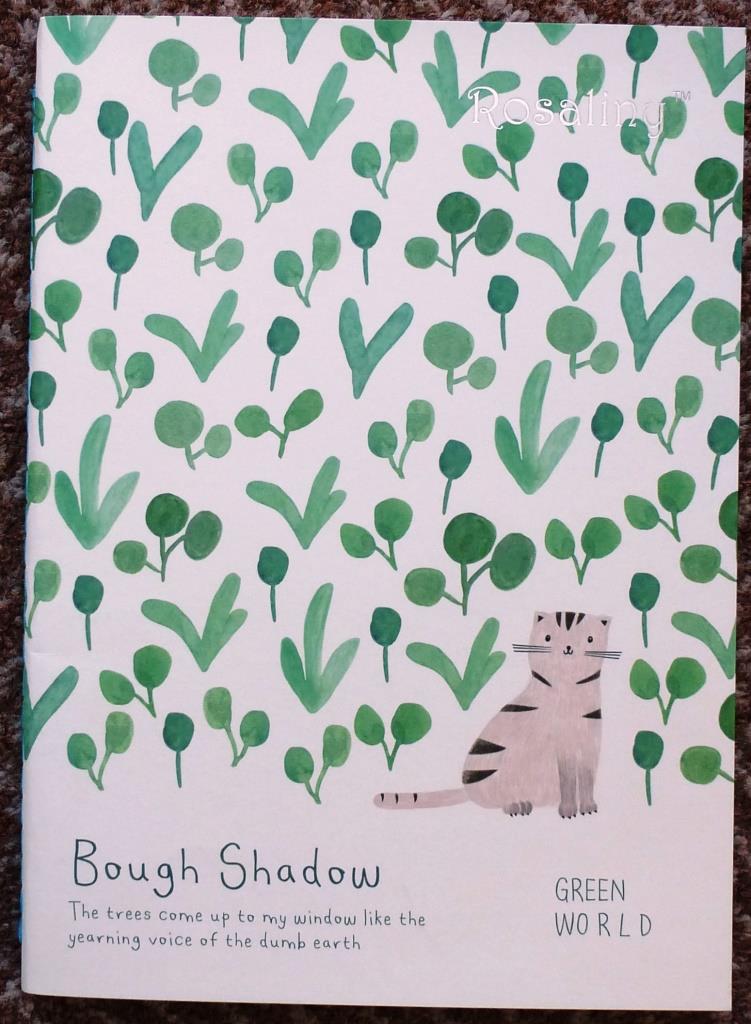
Rosaliny Green World 4 Assorted Softcover B5 Composition Notebooks

I've been on a bit of notebook-buying spree. After renovating an old Filofax Deskfax to create a B5 sized Traveller's Notebook, I (naturally) needed to buy lots of B5 notebooks!

B5 is just about the perfect size for me, I think. I find A5 a little on the small side, but A4 a bit too large sometimes. B5 sits between those two sizes at 176mm x 250mm (c.f. A5 at 148mm x 210mm and A4 at 210mm x 297mm). And of course, it's the perfect size for my renovated Deskfax.

I use my Deskfax as a writing TN - if I'm travelling, it has enough cards and pockets and so on, that I don't really need to have anything else in my bag, and the covers are sturdy enough to lean on if there isn't a table. (You can see what features the writing TN has here.)

In the early stages of writing a book, I use small, slim notebooks to bounce ideas around. Some (most!) of these ideas may never make it to a full book, but I like to keep them anyway. Once I think an idea has enough legs to make it to being a full novel, I need a thicker book (like the Zhi Jin notebook, reviewed here). I quite like the slim books made by Penco or Stalogy but saw some slightly more attractive slim notebooks on Amazon, while I was looking at the Zhi Jin.

The Rosaliny Green World notebooks were £8.99 from Amazon with free delivery and looked like a nice set of notebooks, so I ordered a pack. They took forever to arrive, not helped by the first order getting lost. Once the seller sent a new set, they took about 10 days to get here and there were some very sweet post-it notes in the parcel too (which I forgot to take pictures of and have now given away).

The notebooks have a reasonably sturdy card cover with quite sweet designs of trees/leaves and cats.


Inside, there are 38 pages (76 sides) and they are sewn rather than stapled. 37 (74) of these are lined; the first/last sheet is plain.


On the lined pages, there is space at the top to note the date and also the day of the week. The very top and bottom lines also have small marks on them to facilitate drawing in columns, should you so desire. The spacing of the small marks is a slightly random 10.8mm (which doesn't seem to relate to a sensible fraction of an inch either). Line spacing is 8mm, with a top margin of 15.5mm and a bottom margin of 14.5mm. There are 28 lines (if you're happy enough to use the bottom line; it would be fine - the small marks are unobtrusive).


How well did they stand up to fountain pen? The paper is described as "100gsm acid-free high quality recyclable ivory paper". I'm not sure if they mean "recyclable" (which surely, all paper is?) or "recycled". The paper does feel as if it is 100gsm and is very smooth.

Amazingly, I don't have a zillion fountain pens inked up at the moment, but I tested the paper with what I had, and with a few other pens I had to hand. I used one of the plain pages at the back of the book to test the pages. I don't imagine the lined paper will perform differently.

The results are a bit mixed...
I tried a 1.1mm stub nib and wet ink combo (usually a bit of a killer in pen tests), plus another italic nib, a standard m nib and then some Pilot Hi-tecpoints and a ballpoint.

The good news...
There's no feathering of the fountain pen ink at all and the paper is smooth to write on.
There's no bleed-through of the stub nib or the italic.

The bad news...
There is bleed-through with almost all the other pens except the ballpoint. The Tombow Object nib was the worst; the Hi-tecpoints were a bit better.
There is show-through for everything. Depending on how much that bugs you, this might be the deal-breaker. For me, the pens I use the most are 1.1mm stub nibs, so the fact these worked so well and show-through isn't too dire, means that I'm happy enough to use them, but might not buy them again to be honest.

Pictures (click to enlarge):
Pen tests
reverse, showing bleed- and show-through
zoom in on the reverse
Overall:
These are sweet little books which will definitely get used for initial notes on books or ideas. As for value for money, compared to the Penco notebooks, you get more pages (74 lined in this c.f. 60 in the Penco) for less money (£2.25 per book here, c.f. The Journal Shop selling Penco at £3.99). But... paper quality is significantly lower than the Penco.

As for comparing to Stalogy, the only UK seller I can find is Tokyo Bike (the listing for the Stalogy is here). They have 68 pages and are £5.50 (I originally got mine from somewhere else and they were £2.50. I wish now I'd bought more!). Again, paper quality on the Stalogy is better, but they are a lot more money per notebook. If you're US based, I think there are more options for purchasing them.

The covers are attractive and sturdy and I like that the pages are sewn rather than stapled. Paper quality lets them down, but at £2.25 each, I shouldn't really complain (I mean, Moleskine get away with charging a lot more money for notebooks and the paper is much worse!). I like the headers with the space for the date (and day), plus the marks to facilitate drawing columns. Line spacing suits me, though those with small writing or a penchant for fine nibs may find it a bit wide.

Overall, I quite like them!