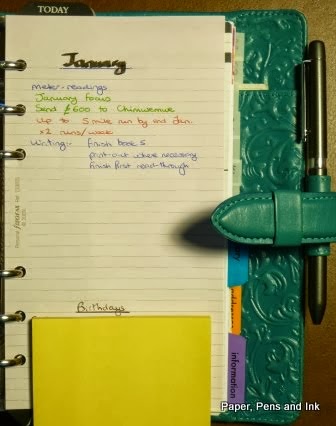
Showing posts with label planner. Show all posts

Saturday, 25 May 2019

My Every Day Carry (#EDC)

It's been a while since I shared my set-up with you, so I thought I'd give you all a quick look at what I'm using at the moment.

I need my EDC to have everything in it. There's no point me having a separate wallet and diary/notebook, because I'll forget one or other of them when I leave the house! But, I need to have something small enough that I don't wreck my back carrying it around! I'm somewhat in awe of people who merrily lug a well-stuffed A5 Filofax or planner around with them. Despite the fact I do always appear to have an enormous handbag, my EDC is pretty small.

For a long while, I'd been using my undyed extra wide pocket from Meadowgate Leather, which is slowly turning the most delicious caramel colour. But this week, I've changed out of that and into another Meadowgate Leather cover that I bought from a Facebook group.

Pocket TN from Meadowgate Leather
with extra width

Sunday, 7 April 2019

Current set-up: diary, to do/notes, and Travellers Notebook

I haven't blogged on here for a while (I've been busy writing and editing my novels, as well as writing for Nero's Notes), but I did tell you about my 2019 diary a while back, so I thought, since we're now in the second quarter of 2019, I should update you on how it's going.

I'm pretty much using the same system that I've used in the past, but with a couple of tweaks. I have my main diary/planner, which lives on my desk and never goes anywhere else, I have a running list of 'stuff to do/remember' and I have my Every Day Carry that is usually in my handbag as it's predominantly a wallet.

Main Diary:


This is still the Box Clever Press one I blogged about. This has honestly been one of the best diaries I have ever used! I'm even using the month at a glance pages (and we all know how terrible I am at knowing what they're for!).

So, why is it so good?

Sunday, 9 December 2018

Short-lived experiment!

Towards the start of October, I was wondering what to use as my diary set-up in 2019. It had been a choice between three TNs (standard, B6 and Field Notes size) or go back to a Filofax. You can see my thoughts about it all here.

I was itching to use my Field Notes size TN, but wasn't sure if I could make it work as wallet, planner and notebook.

Short answer... Nope. Well, not quite as I had thought I would.

I'd bought a fairly cheap diary to fit in it (the teNeues one... see here for the blog post on it), which had a vertical layout. It fitted in okay, though the TN ended up a bit of a chunky monkey with that, a wallet insert and a home-made credit card insert. The teNeues diary started in December, so I thought I would trial it, and see how it went (while I still also had my standard size, vertical layout, Midori TN diary to hand). I could have made it less chunky by removing the cover of the diary, but it wasn't really the chunkiness that made it not work, it was the fact the small diary wasn't big enough for me to plan my days and weeks in.

Wednesday, 10 October 2018

What diary to use in 2019?

I know... it's barely October! And I don't normally have things planned hugely in advance, but we have just booked our summer holidays for 2019 and I'm feeling a bit twitchy that other than scribbling them down on the 'forward planner' bit I've created on the inside cover of my current diary, I have nowhere to put them down! I don't even have a wall calendar for 2019 and I'm sure magazines (like Country Living etc) have included them with the magazines by now.

Anyway, it's got me thinking about what to use for 2019. I currently have three options, though I may throw in a fourth just for shits and giggles.

1. Keep going with my standard-size Traveller's Notebook
2. Move to my B6 Traveller's Notebook
3. Move to a Field Notes size TN
4. Go back to using a Filofax

Monday, 20 November 2017

What I'm using in 2018... part 1

Hello all! Remember me?? I'm the blogger who used to post a LOT more regularly about stationery...

Where have I been?

Publishing another book for a start... "Lies That Poison" came out in September and I was super-busy getting that ready... then The Wrong Kind of Clouds got re-published as "The Call" this week and I was super-busy with that too!

But, back to stationery... I've just about got sorted with what I'm using next year! This post will be about what I'm using as my planner in 2018.

Monday, 2 May 2016

Bullet journalling update: A6 for day to day stuff

The A5 is very much a work in progress, as is the A6, but using the A6 has been an eye opener!

I'm using an A6 Clairefontaine 1951 school style notebook with grid pages, from Bureau Direct. The paper is great, the size is perfect and they are really cheap to buy!

Cover
[I'm not sure why I've written the date range on the front as I shall be throwing it away once it's finished...]

I started using it a couple of days before I went away on holiday and had a day per page for the days before I went away. I used them to jot down everything that needed doing before we went away. I used a simple dot to denote a task to be done, which got crossed through once completed. A  dash indicated a piece of information (but wasn't really getting used). An arrow through a dot meant it was rescheduled.


I didn't leave space for the index. I only remembered about that after I'd started filling things in from page 1 of the notebook. My index is now at the back (which, in fairness, is where most are in books...). Also at the back is a page for 'waiting on' which notes not just parcels/orders I'm waiting to be delivered, but also email replies etc that I'm waiting for. In essence, anything I'm waiting for! Dots indicate still waiting; crossed through indicates arrived.


Another page at the back is for books - books I want to buy/borrow from the library. I managed to be marginally more artistic with this header and draw a banner rather than just a squiggly line. Again, dot next to a title means not yet bought/borrowed; cross means bought/borrowed. There's also a page for noting down blog post ideas, one of things to look up and one for general notes.

The real work is being done at the front though. After the days leading up to the holiday, there are single pages per day for the days of the holiday. I didn't want to take my journal away with me but I wanted to be able to fill it in when I came back, so each day while we were away, I noted what the weather was like (hey, I'm British. We just do that kind of thing...), what we'd done each day, anything else notable, something I was grateful for and something I was proud of. The notes helped me to write up my journal when I got back.

I was also aware, even before I went away, that I needed to remind myself about stuff for when I came back and I knew that I wanted to see if I could find a better system for day to day planning than the hateful ABP2 (which I have abandoned...). I decided I would use a double spread for each day and note things that needed to be done that day on the RHS page and use the LHS for time-boxing. I drew out the little flags and put each date in for each day (I'm seriously NOT very artistic!) and wrote the times of the day down the LHS, leaving some space at the top in case I needed to note things like birthdays etc. The right hand edge of the timed side is to note down anything else important - what my hubby is doing for example and whether the car is with him, or a timed delivery slot. In the picture below, this is what it looks like after things have been allocated, but before I do my day-planning.


The RHS is a combination of brain dump and tasks migrating from the monthly list in the A5. I realise I might be better off with it all in one thing, but A5 is too big for sitting open on my desk and carrying around with me and A6 is too small for the monthly lists, so a combination it is. Since I do a weekly review (and monthly), I can tick things off each week as they get done, during the review session. After I've done the review, I draw out the flags for the dates for the following week, add in the times and then allocate tasks.

My morning routine is to clear my head into the RHS list and review the day before, transferring anything over to the new day that needs doing (or just crossing it out if it's never going to happen!). I've not really done this yet, but the intention for forthcoming weeks is to put tasks relating to goals in colour (coded to the life-area) and brain-dump tasks in black biro/pencil to distinguish between them. The goal-related tasks will get allocated in the weekly review.

Once I have my list, I time-box my day out on the LHS. If anything occurs to me during the day, it gets added to the notebook in the appropriate place. In the picture below, you can see the list of things on the RHS (some of which got re-scheduled, some of which got done) and the time-boxing on the LHS. The pencil is covering up a phone number I jotted down; the crossed out set of numbers was another reminder for something.

An example of what it looks like at the end of a day!


Advantages and Disadvantages so far...

Advantages:
I actually use it. I could have done everything I've just outlined in the ABP2, but I didn't because the line spacing was too tiny and I hated it.
I feel like I'm getting more done and am more organised (but that may be novelty value...).
The system is really simple - any notebook and pen could be used and you can invent your own coding for task/meeting/email etc.

Disadvantages:
I still need my diary. Which means that I now have three things on the go - my diary (in my TN which is also my wallet), the monthly goals (in the A5 - see the last post) and this day to day list. I don't have many appointments, but I do have some. I could have a monthly list in the A6 (in the bullet journal way) and add appointments to it, but I don't have that in there yet and I do like to see an overview of my week. I could draw up a weekly view in an A5 and combine the yearly, quarterly, monthly and weekly plans into one place, but the size is too big. I could draw up weekly views in the A6 but that would take up too many pages. I could draw up weekly views in another A6 and put both that A6 and this day planner into the Fauxdori I made myself and go back to a wallet and A6 TN... and then I would forget one or the other when I left the house probably.
I could also easily stick with what I'm doing and just accept that things are a bit scattered while I work out what's for the best!

I've not quite cracked it yet... no doubt more soon!

How are others using a bullet journal? More conventionally (all in one book) or more scattered (or scatty?) like this?

Wednesday, 30 December 2015

Planning 2016

2016 is going to be a busy year for me! My first book, The Wrong Kind of Clouds is due out in spring and there will be a lot of things needing to be done relating to that (you can see all my posts about that here). Then I have at least two books to edit and get ready for publishing, and somewhere in all that, I have to write the book that is threatening to eat my brains if I don't get it out of my head and on to paper! Oh, and it seems life doesn't stop, just because you're busy, so there's also all the general 'stuff' that needs doing, in order to live.

Thankfully, I've always been a pretty good planner. Even more usefully, I have a cupboard full of notebooks and paper, because I am an unrepentant stationery buyer and hoarder. My only problem is that I can find it quite hard to start a notebook!

However, one of the delights of this time of the year, is to get out a selection of notebooks from the stash and choose one to use for planning. When I say 'selection' I do of course mean the equivalent of a small stationery store.

So, I merrily pulled out a collection of notebooks and wondered which, if any, would be right for planning such a busy and momentous year.

And that's where the problems started...

In the past, I've tended to use a Filofax for general planning, mostly because of being able to move pages around within the binder. With a Filofax, I can have different sections for different projects and add/remove pages as and when needed. But, I fancied a change. I wanted to have my notes bound together rather than loose-leaf, because this year isn't just any old year getting planned. This is the year I actually get to call myself a published writer!

Most of my notebook stash are bound books and I initially thought that these would be excellent to plan and record 2016. Excellent! A bound summary of the year, tying together the planning and the results.

Two minutes' thought later...

How was I going to do this? Did I put all my goals at the start and then just fill the pages as I went along? Aagh!! I don't have the right character for that! All the notes on a single project, scattered through a book? No. My brain started turning into grey goo at the mere concept.

Could I leave gaps between the different projects so they each had 20 pages or something? Oh, but what if I needed to write more on something and then ran out of pages? Then I'd be back to notes being all over the place.

Then it occurred to me that I could have the flexibility of a binder but keep all my notes for a project bound together, by using a Traveller's Notebook. Then I could have a separate booklet for each project, which would give me the flexibility for adding new notebooks if needed (or abandoning them) but still let me have all my project notes in one place.

Hurrah!!

Except the one I have, is currently used for my wallet and day-to-day diary combined.

Quelle dommage... I would need to buy another...

So, that's what I've done!! More on it once it arrives!

Saturday, 1 August 2015

I STILL do not get monthly pages...

This week, over on Philofaxy, there were several posts in the list of Web Finds for August 1st that featured how to use the monthly spread. I read them keenly - the monthly pages are something I can NEVER get to work for me. Maybe seeing how others use them would help?

I still don't get them.

Absolutely NO disrespect to all of you who use the monthly pages and who make them work well for you, but I really cannot seem to make them work for me. I either want to put too much stuff in the boxes and then can't see the wood for the trees, or I put too little stuff in and miss it. Or I don't transfer information to my weekly pages. Since I have the rest of the year in my week to view (or week + notes) to hand, I would never put an appointment in the monthly pages - I would put it straight into the weekly ones. If it's for a date after the end of the year, I write it on the last page/in the notes pages and transfer it to the new diary when I have it.

If I need an overview of the month, I flip through the weekly pages. Each month, when I'm working out what I want to get done in the next month, I look at my next tasks/project lists and the pages of my weekly diary and allocate tasks based on how much is already in that week. I don't have many externally imposed deadlines, but I impose deadlines on myself and allocate accordingly. Birthdays get written into the weekly diary when I buy it and reminders to send cards/presents/arrange something are put in the weekly diary, the appropriate number of days before the birthday.

When I plan out my week, I use a combination of the weekly pages and a daily scratch pad to sketch out my days. I allocate tasks to each day when I do my weekly review (usually on a Sunday) and then at the start of each day I draft out, using time-boxes, when those tasks will get done.

I have tried and tried monthly pages! I've tried them in my Filofax to be able to reduce the number of weekly pages that I need to carry, but I just hated it - the boxes were too small. I've tried sketching out a month on A4 squared paper so that I can have it on my desk to make me see what I have on for the month, but I then pile books on top of it/don't fill it in/feel as if the whole month is empty because not enough detail of my day to day schedule is on there...

I've come to the conclusion that if it ain't broke, don't try and fix it and despite admiring those who can really work the monthly pages, I have had to accept that I will just not be one of them!

Anyone else find the monthly sheets difficult to work out? Or am I alone on this??

Monday, 9 March 2015

How have I ended up using four things for planning??

It struck me the other day that I seem to have migrated to using four things for daily planning:
  • the planning filofax
  • the daily carry-around
  • a vertical WO2P in an A5 filofax
  • a reporters' notebook
What??? I thought I was all streamlined into a compact filofax! How did this happen??

Well, it's actually not as bad as it sounds. Honest! I realise that what I have done is just reproduce the system I always used to have, but distributed it over several things in order to use a slimline as a carry-around.

My system has almost always (well, since I have had a 'system') included:
  • a goals to projects to next actions section (which is now in the planning filofax along with spare diary pages - see here for how I get that to work)
  • a week to view for an overview (which is still in the carry-around)
  • a daily list + a daily plan (which I used to have on DPP in the carry-around when I had the ring-space, with appointments/time-sensitive tasks down the left and the rest of the daily list on the right)
It's this last bit that has morphed into two separate things I suppose. Patty from Homemakers Daily did a good post (read it here) about the difference between a  daily list and a daily plan. For me, the daily list - the list of things I need to do today - is going in the reporters' notebook. Then each morning I am drawing up my daily plan which is getting time-boxed into the vertical WO2P in the A5.

I had been doing that on the WO2P in the de Villiers, with the daily-list on the right of each day-box and the plan on the left, but it was starting to get too crowded when I had lots of 'mosquito tasks' to clear and so I started scrawling things in the notebook. I could just move back to using a DPP, the way I always used to and keep everything in one place, but at the moment I am still off work and so still based at home on a daily basis and I have a big desk and an A5 diary to use up and a stack of reporters' notebooks to use up, so why either buy or print up DPP?

No doubt I will go back to the 'all in one' binder at some point, but this is working okay for me at the moment (and handily using up the A5 diary and rubbish notebooks!).

Anyone else find that they think they've started using a new system, only to realise it's the old system in different clothes?


Monday, 15 December 2014

spanners

A few weeks ago, I thought I would use one of my (many) Leuchtturm A5 notebooks as a 2015 goal/project planner. There are enough pages in one to have 4 pages for every week, monthly planning pages and a few pages at the back for a year-review too. I would have set up the 249 pages as so:

Page 1: goals for the year
Page 2: Quarter 1 goals
Page 3: Quarter 2 goals
Page 4: Quarter 3 goals
Page 5: Quarter 4 goals
Pages 6-29: Two pages per month for notes/goals/lists/anything and everything
Pages 30-241: Four pages for every week (allowing for an extra week to overlap the end of 2014 and the start of 2016)
[The pages would be split into: notes for the week + Mon; Tue + Wed; Thu + Fri; Sat + Sun]
Pages 242-249: Review of the year

That, of course, was all before I hit burnout. Right now, I can’t even think what I will be doing in January, never mind the rest of 2015. Actually, I can’t even think what I will be doing tomorrow, never mind January!

Maybe I can just start to use a Leuchtturm A5 like this once I’m able to start contemplating planning again.

Does anyone else use a notebook for a home-made planner like this? If so, what do you use and how do you use it?

Monday, 15 September 2014

My current planning system

In my last post, I described how I think (think) I have reached planner peace and a set-up that is really working for me. I have moved to using a slimline filofax which has necessitated me modifying my set-up a little, though in essence ‘The System’ is the same.

What I use now is a combination of the de Villiers which goes everywhere with me, and a regular-sized filofax which stays at home (currently I’m using the wine Holborn but I do have a selection to choose from!). Let me walk you through what is in each of these, then try to explain The System.

The De Villiers (wallet and planner combination)
From front to back:
  • Inside front cover: 10 card slots carrying all my bank and loyalty cards, stamps, donor card etc.
  • Plastic fly-leaf with Leuchtturm stick-on pen holder, holding my Zebra diary pen/pencil
  • Weekly list for the current week
  • Weekly lists for the next three weeks
  • Notes Tab
  • Three or four sheets of notepaper for scribbling things to remember into (‘capture’ list)
  • Diary Tab
  • Monthly sheets for the rest of 2014 (4 pages for each month: monthly list, month to view, review)
  • Week to view diary for the rest of 2014 (from Paperchase)
  • Page for forward planning
  • Information Tab
  • Personal information sheets
  • List of books to look for
  • List of maps we have
  • Note of my weight and miles run per week
  • Addresses Tab
  • Address sheets
  • Plastic zip-up pencil case with money in
  • Inside back cover: paper money in the outer pocket; receipts in the inner one
Left - card slots; right - fly-leaf with pen-holder, weekly sheet
weekly sheet
There are 4 weekly sheets in at a time; review space on reverse of the lists
Monthly list (r); review of previous month (l)
Month to view
Plastic pencil case with coins in
Paper money in back pocket

The Holborn (storage of non-current planning pages)
From front to back:
  • Nothing in either the front or back covers
  • Plastic fly-leaf
  • Page saying, “You mustn’t be afraid to dream a little bigger darling” (quote from the film Inception)
  • Tab
  • General (big) to-do
  • Annual plans
  • Quarterly plans
  • Page(s) for each life area and their goals (mostly too personal to share), with next actions under each goal
  • Tab
  • Monthly review checklist
  • Spent monthly pages (kept only for the purpose of quarterly and yearly reviews – they will get thrown away at the end of the year)
  • Tab
  • Weekly review checklist
  • Weekly sheets – both from the past and the remainder of the year (only four weeks of these are in the de Villiers at any time). Again, all of these will get thrown away at the end of the year.
  • Week on two pages from the past (current are in the de Villiers – there are no more than 6 months in the de Villiers at a time)
  • Tab
  • Other information sheets that I don’t need to carry around with me e.g. peak flow record, notes, log suppliers, things bought for presents over the last few years, maps, packing lists

How do these two binders work together?The System
The key aspect is the weekly review (though the monthly one is important too).
Each week, I try to do the following:
  • Go through the notes pages and make sure everything has been dealt with/filed/sorted one way or another
  • Go through my list from the week just past and reflect on what did/didn’t get done and why
  • Tick off things in the monthly list; add anything that has come up
  • Transfer to the coming week’s list anything left from the one just finishing, starring them to indicate they have already had a week (or more) and not been done
  • Transfer the weekly sheet to the Holborn binder and get the next one to go in the de Villiers out (I keep 4 weeks of weekly sheets in the de Villiers)
  • Look at the monthly list and the week to view diary and note down in red pen at the bottom of the weekly list any appointments (ignoring work ones!) and things that I need to do like send a birthday card
  • Look at the monthly list of big to-do and next actions. Tick off things done and think about what might sensibly be achieved in the next week. Write these into the space at the top half of the page
  • Clear my brain of any other to-do into the bottom half of the page
  • If I’m feeling adventurous (or mad) I write the day on which I think I will do these next actions and to-do in the space next to them. This may or may not reflect reality!
  • Have a quick flick through to the rest of the month (and the following one if it’s near the end of the month) just to check what is coming up

What I try to do when I am not at work (i.e. evenings, days off, weekends):
  • Open my binder to the weekly list
  • Plan what I can do from it that morning/afternoon/evening
  • Do it

What I try to do monthly:
  • Look at my weekly and monthly list(s) from that month and reflect on what did/didn’t get done and why
  • Take out the finished monthly sheet from the de Villiers and file it in the Holborn
  • Transfer anything not done onto the sheet for the following month and star them to indicate they have been carried over
  • Look at the lists of big to-do and next actions and the monthly overview and try and think what I might sensibly manage to achieve in the coming month
  • Look at that list again and consider removing 20% of it because I know I over-allocate
  • Flick through the next six months of diary to remind myself what’s on the radar

Appointments go straight into the week to view diary (if I have them in the de Villiers – I can only carry 6 months of pages so for anything further forward than that, I just put it in the notes section and transfer it at the weekly review; 99% of things can go straight into the pages).

So, that’s The System. When I do all that, I feel more organised than when I don’t. There is then always a danger that I feel over-planned and then go ‘to hang with it all’ and ignore all plans, lists, goals etc. until I’m as organised as a bowl of cooked spaghetti, at which point I start doing The System again!

What do people think? What’s your set-up like (and would you like to do a guest post on it?)?

Friday, 12 September 2014

Planner Peace??

Have I finally got there? Jeez, it’s been like trying to find the end of the rainbow! Anyway, I think (think...) I have finally reached some kind of planner peace. To the point of not even looking at binders on eBay. Well... not every day.

So, what does this planner peace look like?

It looks like my de Villiers still!


I have made a couple of small changes to the set-up but nothing major. Instead of the giant to-do list at the front with a reminder on it to look at my next-actions list, I have gone back to my weekly sheets. These at least were split into ‘next action’ and ‘to-do’ (things that need doing but which aren’t part of a project or goal). The instruction: ‘turn over and look at your next actions’, somewhat as anticipated, didn’t work! I am incapable of turning the page it seems. Even when told to.

Another problem was partly to do with my next actions which were too big and needed breaking down into smaller ones. So, for instance, ‘finish book 6’ was a giant of a next action, whereas ‘finish the scene where x happens...’ was a much easier task! Consequently I have worked on making my next actions things that are achievable in a day/week (so that they can get ticked off the list!).

The weekly page set-up is shown below. Next actions go in the top half. You’ll see that I’m using up cut-down sheets from a non-filofax brand, just to use them up. Next year I will be using glorious, glorious Tomoe River paper (more on that in a future post). In the bottom half of the page I note other non-goal ‘to-do’ and any birthdays or appointments are noted in red at the very bottom of the page (to remind me to go to them or do something about them). Already written in, is a reminder to do the weekly review!
The reverse of the weekly list has space for the weekly review. Sometimes I do this following a set structure; often I just reflect on what did or didn’t get done and why.

Weekly list: next actions at the top, to do below
Review on the reverse; following week on RHS

By going back to the weekly sheets, it forced me to do my weekly reviews and to rewrite onto the following week’s sheet anything not achieved, something that generally spurred me into doing said thing(s)!

The only other change has been to try (try!) and use monthly sheets in as much as I have put highlighter on days I am not at work to try and help me see how much time I have ‘free’ (i.e. not at work) in the month. I’m still not great at working out what level of detail should be on there. I have got as far as marking off work days and birthdays and events such as away for a weekend. It still seems like it’s both too much and too little detail. But putting highlighter on and having a reality check over how many days I have a week/month to get things done in, has made my monthly lists more sensible.

Pink indicates not at work!

In the next post, I will do a review of my planning system as I realise it has changed a little since the last time I posted about it.

Has anyone else found planner peace recently? How long do you think it will last??

Monday, 30 December 2013

My planning system, 2014

In essence, my planning system for 2014 is the same as it was in 2012... so yes, I am probably getting a cheap post out of this!

Anyway, in the last two posts, I outlined my monthly and weekly sheets and then my goals to projects to next actions, but how does it all fit together? The keys to it all are the reviews, especially the weekly review.

What I do each week (this will look like a massive list but it only takes me 20-30 minutes each week):
  • Collect stray notes, receipts, jottings etc. and process into the right place (this includes my desk as well as my filofax!)
  • Make sure there are a few sheets of notepaper in the ‘notes’ section of the day to day binder
  • Take the weekly plan for the week just passed out of the binder so I can write my review of it on the back
  • Look back over the list of tasks for the week just passed and see what got done and what didn’t
  • Reflect on why things did or didn’t get done
  • Not beat myself up (too much) if plans have slipped – life happens
  • Transfer any outstanding tasks to the sheet for this week’s plan, putting them into the right places of ‘to do’ or next action’
  • Take the sheet for this week out of the binder so I can see it while I have my week to view open (no, I can’t flip pages... I just can’t)
  • Allocate tasks to days if possible (being sensible about the laws of time and all that)
  • Anything not allocated to a day, write on a Post-It note, headed ‘things to do at some point this week’ (make sure the sticky bit of the Post-It is at the top)
  • Stick Post-It note into diary on RHS
  • Look at the monthly sheet for this month and see how well (badly) it’s going with regards to task completion
  • Not beat myself up if things are slipping and remind myself that life happens (and only happens once)
  • Look ahead four weeks to remind myself what is coming up
  • Add any reminders into the weekly sheets (i.e. to buy a birthday present or organise a dinner etc...) that I’ve suddenly spotted by looking ahead 4 weeks
  • Flick through all the life-area sheets and make sure there are next actions or milestones for each project/goal
  • Put weekly sheet for week just passed into the back of the navy Portland
  • Close both binders
  • Feel organised (and slightly smug)
Monthly sheet

How the week to view ends up

During the week, once I get to the end of Tuesday, I move the Post-It note to the LHS (hence the sticky bit needing to be at the top) – I can still see Wednesday but I can now also see the rest of the week too, so things on Thursday (covered by the Post-It on Monday and Tuesday) don’t suddenly sneak up on me.

What I intend to be doing each month, but it all went a bit pear-shaped last year, so here’s hoping I get my sh*t together this year:
  • Take the sheet for this month out of the day to day planner so I can write my review on the back
  • Look at what did/didn’t get done over the month
  • Reflect on why things did/didn’t get done
  • Not beat myself up about it all because life happens (just once)
  • Take the sheet for the coming month out of the navy Portland
  • Transfer outstanding tasks from last month’s sheet to the coming month’s sheet
  • Put the sheet from last month into the back of the navy Portland
  • Look at the goals-projects-next action sheets carefully: are the goals still valid? Have plans changed? Have new things developed? Are the next actions sensible and applicable still?
  • Take out the weekly sheets for the coming month from the navy Portland
  • Transfer things from the monthly sheets to the weekly sheets
  • Look ahead six months
  • Note anything that has ‘appeared’ (i.e. has always been there, I just forgot about it) and whether I need to do anything about it – if so, put a note in the appropriate weekly sheet
  • Do the weekly review
  • Feel doubly organised (and smug)

Well, that’s my system – what do others do?

Thursday, 26 December 2013

Getting ready for 2014

Ooh... I feel all prepared and organised. Well, somewhat! After some interesting, inspiring and fun discussions with Shadow Wolf over email, I became enthused about getting set up for 2014 so have spent a couple of days preparing things.

Despite still not being 100% sure about my goals and next actions (yep... still working on them), I did know that I needed monthly sheets and weekly sheets and that my weekly sheets needed dividing into ‘next actions’ space and ‘to do’ space (in my head, ‘to do’ are things that need doing like buying stamps, writing to a friend, getting the dry-cleaning, doing the housework, whereas ‘next actions’ are the things I have to do to progress my projects and hence approach achieving my goals). This year I have struggled a bit with ‘to do’ beginning to swamp me and ‘next actions’ getting forgotten and I am determined that this won’t be the case in 2014!

Whereas my homemade week + notes is designed around me and would have been a perfect set-up for 2014, I am also getting annoyed with myself for buying perfectly good diary pages and then printing up my own anyway, so I have decided to stick with the Paperchase week to view (which I reviewed here) and amend it slightly.

My set-up (and I am really hoping that despite all the siren-songs from Red shiny people, I may stay in it!) therefore runs like this:
  • Goals to Projects to Next Actions (held in the navy Portland)
  • Monthly sheets (all bar the current month held in the navy Portland; current month’s sheet is in the day-to-day binder)
  • Weekly sheets (all bar the current month’s weekly sheets held in the navy Portland; current month’s weekly sheets are in the day-to-day binder behind the current monthly sheet)
  • Week to view (whole year in the day-to-day binder)

In detail
1. Goals to Projects to Next-Actions
Still a work-in-progress at the moment but I am hoping to map them out over the next few days!

2. Monthly sheets
Still also somewhat a work-in-progress as the next-actions are nowhere to be seen yet. However, the rest has been set up.

sample monthly sheet
I have used lavender-coloured paper and a separate sheet for each month. The month is written across the top then there is a space for writing in all the next-actions and any month-specific to do (like renew the car insurance, etc.). At the bottom is a reminder of all the birthdays that month (covered up in the photograph). You can see November in the picture (fewest birthdays to hide!) and a few things in on the monthly list (but not many! It is for November 2014 after all).
The reverse of these sheets just has ‘Review’ written across the top and will be where the monthly review gets written up.

3. Weekly sheets
These used to work so well for me and I don’t understand why I let them slip. They are effectively the ‘+ notes’ part of the week + notes format, only with space for the weekly review on the reverse.

sample weekly sheet

I have split each week into ‘to do’ and ‘next actions’ as explained earlier. And yes, I have drawn up all the weekly sheets needed for 2014 and in every single one I have written ‘weekly review’ (as well as ‘monthly review’ and ‘quarterly review’ where appropriate). Shown in the photograph is a sample week (with not a lot to do in it yet!). I was going to write all of these out on nice cotton-cream paper but then found a heap of quadrille paper and thought I would use it up (yes, it was Time Manager paper and I trimmed it and re-punched it to fit). In the monthly review, these sheets will get filled up with ‘next actions’. I have put in all the ‘buy card and present for x’ reminders over the whole year too, as well as ‘post card and present to x’ (yes – that level of reminder is needed!)

4. Paperchase Week to View Diary
These pages live in the turquoise Baroque (current day-to-day binder). Since the week to view has to cover both appointments and tick-lists and since my Virgoan/OCD-squeakiness makes me not want to mix these up on the page, I have split every day into two, with appointments to go on the left and tick-lists to go one the right. (This might have taken less time if the lines weren’t all precisely a Today-ruler’s width from the edge of the lines...)

sample week to view
I also realised that I need to make a bit more effort over some habit-tracking. If things aren’t actually written down on a day, I won’t necessarily do them. However, my Virgoan/completer-finisher/OCD-squeakiness makes me determined to tick something off if it appears on a day! Hence, on each day, I have either got ‘core’ or ‘rowing’ (by which I mean rowing like rowing a boat, not rowing like having an argument!) and on Sunday I have to do both, so have both written in, with a small square to tick. No, I’m not joking. All 365 days of 2014 have one or both of these written in.

I became sloppy about doing my weekly reviews last year – probably a major reason why my goals slipped and non-goals-busyness took over. To try and avoid that this year, on every Sunday I have ‘review’ written and there are also indications of when I have more than one to do (monthly and/or quarterly), so I get to tick them off on the day and on the weekly sheets!

Since I am incapable of turning a page to look at the weekly sheets, I will also have their lists on Post-It notes on the weekly pages too. I know – why have the weekly sheets at all if I’m not going to look at them? I don’t know. I need them when I plan the month and I like to have them for the weekly review, but I’m just hopeless at looking at them in the week itself and if I allocate tasks to specific days I tend to overload myself and get frustrated by a lack of flexibility, so I have tasks on the Post-Its and throw them away at the end of the week.

The only other thing I have done to the diary, is the minuscule amount of washi tape you can see. Although I love the idea of washi tape and have a fine collection myself, I can never cope with it on the days of my diary, any more than I really can cope with stickers. Whereas I love seeing what others are doing when they decorate their pages, I think I am too much of a ‘clean-line, no clutter’ person in my diary. So, my concession to washi tape in the diary is to put a little bar of it along the top corner, coded to indicate the month. It makes the page (a little) more interesting but doesn’t swamp the point of the WO2P of showing me what and when I am doing things.

Anyway, that’s my set-up. What about everyone else? Are other people as bonkers as this or am I the only one who finds sitting down and prepping the year like this soothing and reassuring?

Friday, 20 December 2013

Perfect planner?

Having reviewed Plannersims Laurie’s “Going Places Planner” and feeling that, although it is a great design, it isn’t quite right for me, I wondered what would be the perfect design for me.

Things I liked the most about the Going Places Planner:
The yearly goals, quarterly goals and monthly goals double-page spreads, the annual review pages and the notes pages. I thought these were great (though perhaps slightly disjointed in their locations in the planner) and would be excellent for collecting plans and goals and for reviewing how things had gone.

What I would change:
I wouldn’t bother with the information pages – I have never used them and they just take up space. I also have struggled to use monthly pages – the ones where there is a box per day in the month. I can never work out with what ‘granularity’ of information goes there and would prefer to just use weekly pages and log everything.
But the biggest change I would make would be to have horizontal week on two pages as the set-up as I would prefer the shallower, wider space rather than the deep, narrow space. Although I use columns in my work A5 diary, for my personal planning (and, I really do keep work and personal as separate as possible!) I work best with horizontal week to view.

This led me to thinking about my current I-have-no-idea-what-my-plans-are fog (that has beset me for months now; see here and here). I’ve been too busy to think, basically. Any time that I’ve not been working or busy with chores/Rotary/family/you name it, I have been writing. I realised a while back that I hadn’t even looked at my goals or projects for weeks and weeks and I wasn’t sure whether the plans I had made at the start of the year were still current.

At some point, I will manage to sit down and have a long think about it all and some of me wondered about using the Going Places Planner from Laurie to plan the year, but it didn’t quite suit me. I then thought about getting a nice A5 book and drawing out my own planner, but to be honest, I don’t think that I would ever really carry a planner and a separate wallet and a separate address book around with me, especially when I am more than happy with an all-in-one combination in a filofax (or Mulberry). Also, there is no reason to carry all that planning around with me – the essential part is the weekly list, not the project notes, or annual and quarterly and monthly parts – and so I could use a filofax (or Mulberry) for my carry-around and another filofax for the planning, which I would look at during the weekly reviews/monthly reviews/quarterly reviews and annual review.

Those of you who read the blog regularly, know that I bought a navy Portland to use as my planning filofax – it’s a gorgeous filofax and I have been itching to use it but I still haven’t. It will look absolutely fabulous with cotton cream inserts and all my goals and next actions laid out. One day. When I’ve finished the first draft of book #5 and put my mind to planning my life properly!

But, I already know what sections I will put in it!

In the Portland there will be the following sections:
Projects (one page for each project; possibly colour-coded as to life-area); broken into ‘next action’ lists
Annual goals (and annual review, at the end of the year); arranged by life-area and then project
Quarterly goals (and quarterly reviews at the end of each quarter); arranged by life-area and then project
Monthly goals (and, yes, you guessed it, monthly reviews at the end of each month); arranged by life-area and then project

There would also be weekly lists of ‘next actions’ (again, arranged by life-area then project) – these would go on Post-It notes in my day-to-day filofax in the week to view section.

Why that order? In my head, the projects have to come first, because without thinking of them overall, I won’t be able to then think what I might achieve in the year. The projects are, in effect, “Everything I want to do in this life-area but might not manage to do in a year” – hence the annual goals. Also, I want the annual/quarterly/monthly goals to be in list-form, without all the detail that will be in the projects section, and with tick boxes next to them!

Once I have set it all up, I will share the details with you all!

What's everyone's perfect planner system? Please share in the comments.

ps – I gave the Going Places Planner to my sister and have asked her to do a guest post on how she uses it.

Wednesday, 18 December 2013

Review of Going Places Planner

Going Places Planner

I was absolutely delighted when Laurie from Plannerisms asked me if I would review one of her Plannerisms Going Places Planners and jumped at the chance. Well, it arrived earlier this week (sadly whilst I was in the throes of marking undergraduate exams and couldn’t look at it properly) and today I’ve managed to have a proper rummage through it and write this review.

Overview:
I was given the choice of colour for the cover and I asked for the teal colour. The book is a nice size – not too large and heavy so those of you who like to carry these things around with you will be able to, but not so small that space becomes an issue. The dimensions are given as 5.5” x 8.5” (142mm x 220mm which is 10mm taller than A5 and a few mm narrower). It being slightly taller than A5 will make it not fit in a slip-cover designed for A5, but Laurie has listed suitable covers on her blog for those of you who want to protect it from the ravages of your bag or want extra features like a pen holder or card slots. The paper inside is high quality and the cover reasonably sturdy, with a vertical elastic closure and two ribbon-markers.

Cover:
The cover is made of PU and has minimal branding – in the bottom right-hand corner of the front is the Plannerisms logo and 2014 over the top of it and on the reverse is the maker’s logo of H+O. The teal is a light teal and the elastic closure matches well.

Back cover
Inside:
The inside cover has a quote from Mark Twain printed on a nicely matched background paper. The first page of the planner proper is for personal information. The listings have a decidedly American slant (understandably) – for example I would always go and see my doctor rather than my physician and my shorthand for ‘number’ is ‘no.’ not ‘#’ (which, as I teach in a medical school instantly makes me think ‘fracture’!).

Mark Twain quote
Personal Information page

After the personal information page, the next double-spread is a reference calendar for 2014 (LHS) and 2015 (RHS). I’ve said before that I never really know what these are for, but presumably others out there find them useful (let me know in the comments of you do and what you use it for?).

Reference calendar

The next double spread is for ‘Goals this year 2014’ with lined pages. The year is in a different coloured font (as they have been in the reference calendar), which makes my OCD tendencies squeak a bit. The lines don’t go right to the edges of the page, have a line spacing of 5.5mm, with a page margin marked in a dark blue top and bottom.

Goals for the year

The following double-page spread has quarterly goals for 2014 (again, the year is in a different colour, as is the middle month of the three in each quarter).

Goals for the quarter

Then there is a Year Planner for 2014, with the months vertical and the weeks marked off (which is a nice touch), then a double-spread of international holidays for major countries. After that there is a double spread of international dialling codes for major countries and some of the cities within some of these countries followed by conversions for weights and measures. Again, maybe I am unique in this, but I never, ever refer to any of these pages and would prefer to have more space for notes. Again – let me know in the comments if you do use these?

Year planner
Information pages
Information pages
Information pages

There then follows a double-page spread titled ‘How to use this planner’, but my personal feeling is that the order isn’t quite right (forgive me Laurie!). My personal preference (and I realise this could be just me) would be to put all the reference stuff either at the back and let people dive right in with the planner (if the reference stuff has to be there at all), or right at the front and then have the ‘How to use this planner’ and THEN have the goals for the year, quarterly goals etc. rather than break up the year goals to quarterly goals to monthly plans flow. This could of course be a reflection of how I set my planners up of goals to next actions to monthly lists.


The ‘meat of the planner’
a) the monthly section:
There is a double-page spread for each month with lined paper to list your goals for the month. These would naturally flow from the yearly goals (and quarterly goals) and which is why I think then breaking this flow with the information pages and ‘how to’ page isn’t quite right. The goals pages are then followed by a double-spread monthly calendar, with a grey-shaded column to the left of the week and the weeks starting on Monday. Each day-box is 30mm wide by 37.5mm tall (just under 1.25” x 1.5”) with the date clearly in the top left-hand corner and any holidays printed in a fairly small font across the top. Thankfully, the ‘New Year’s Day’ doesn’t then list all the countries for which January 1st is New Year’s Day (as Moleskine and other diaries do, which takes up the ENTIRE box!!).

Monthly goals
Monthly overview

The monthly pages follow one month after another in a section, after which is:

b) the weekly section:
The layout of the week-to-view pages is a grey column to the left of the week, then equal-sized (30mm) columns for all of the week (no squashed weekends) starting on a Monday. The day-columns don’t extend to the bottom of the page and are untimed, but are lined. Across the bottom is a large, unlined space for extra notes, with one of those days:dates calendars for the month in the bottom right-hand side. At the top of the left-hand page each week is a motivational sentence/advice for sticking to your goals.

Weekly layout
Motivational quotes

Now, for me, the vertical layout will be a challenge. Whereas I LOVE the vertical layout for my work diary, in my personal diary I have never got it to work. My work diary is a vertical week on a page and a bit with a notes section on the right (you can see the layout here) but in all my filofaxes or other planners I have always preferred a horizontal layout for the week. I think it’s because for my personal planning, I have few appointments but lots to plan and so like a wide oblong to write in, whereas at work I have appointments that need blocking off and a big space for notes at the side. For this reason, I’m not sure how successful the planner would be for me. The yearly goals, quarterly goals and lined monthly goals pages will be brilliant for me, but the monthly spread of dates and the weekly pages will be a challenge.

c) back of the planner:
After the last of the weekly spreads is a double-spread year planner for 2015, followed by two pages for an annual review and four pages for notes. The very back page has some information about Laurie herself.

Year planner for 2015

Annual review pages

Notes pages

Back cover

d) the pocket in the back cover:
There is a slip pocket in the back cover with a notes-book in it. The pocket is made of the same, thicker paper that lines the planner, with a glossy inner to the pocket. As I understand, last year the little booklet in the planner was an address-book, but this year it is a notes-book. The notes-book is 109mm x 180mm (4 6/16 x 7 10/16 inches), has a front page for the same personal information as the planner then 15 sides of notes pages, lined with a very narrow 4.75mm line-spacing (3/16th inch).

Notes book

Inside notes book

Notes pages in the booklet

Flattability:
It might get better with use, but at the moment it is pretty resistant to lying flat and is in no way bat-like in its flatness. When the book is open in the middle, the cover is lying flat but the pages are a bit ‘sprung’ and writing in the day columns for Wednesday and Thursday will involve a bit of brutality to make it easier.

Ribbon markers:
Regular readers will know quite how much unmatched ribbon markers and elastic closure annoy me and make my OCD tendencies squeak. The two ribbon markers in the Plannerisms planner are green/teal and black. The black complements the planner beautifully and the green/teal is a close enough match that I’m not upset!

I haven’t done a fountain-pen test for a couple of reasons. One: I hate spoiling books by doing them and prefer it if I can just remove a page to do the test (which I can’t here) and two: I’m not ready to write in it yet as I am still in the I-don’t-have-a-clue-what-my-goals-are fog. I will update this/report back once I have.

Overall:
It’s not the perfect layout for me, but it is a really beautiful book and very well thought-out. It is a great size and weight (300g) if you wanted to carry it around – it certainly weighs a lot less than my Baroque filofax (which is currently 585g, though this is my wallet as well as my planner). My preferred layout would be the week to view with a horizontal layout rather than vertical and I wouldn’t separate the yearly and quarterly goals from the monthly and weekly section. Personally, since I never use them, I would also replace all of the information pages and the year calendars with more notes pages (but I recognise I am probably in a minority over this!). At some point I will work out how to use the monthly spreads too (but the monthly note pages are brilliant!).

Thank you again to Laurie for sending me one of her planners to review!

You can order a Going Places Planner here.